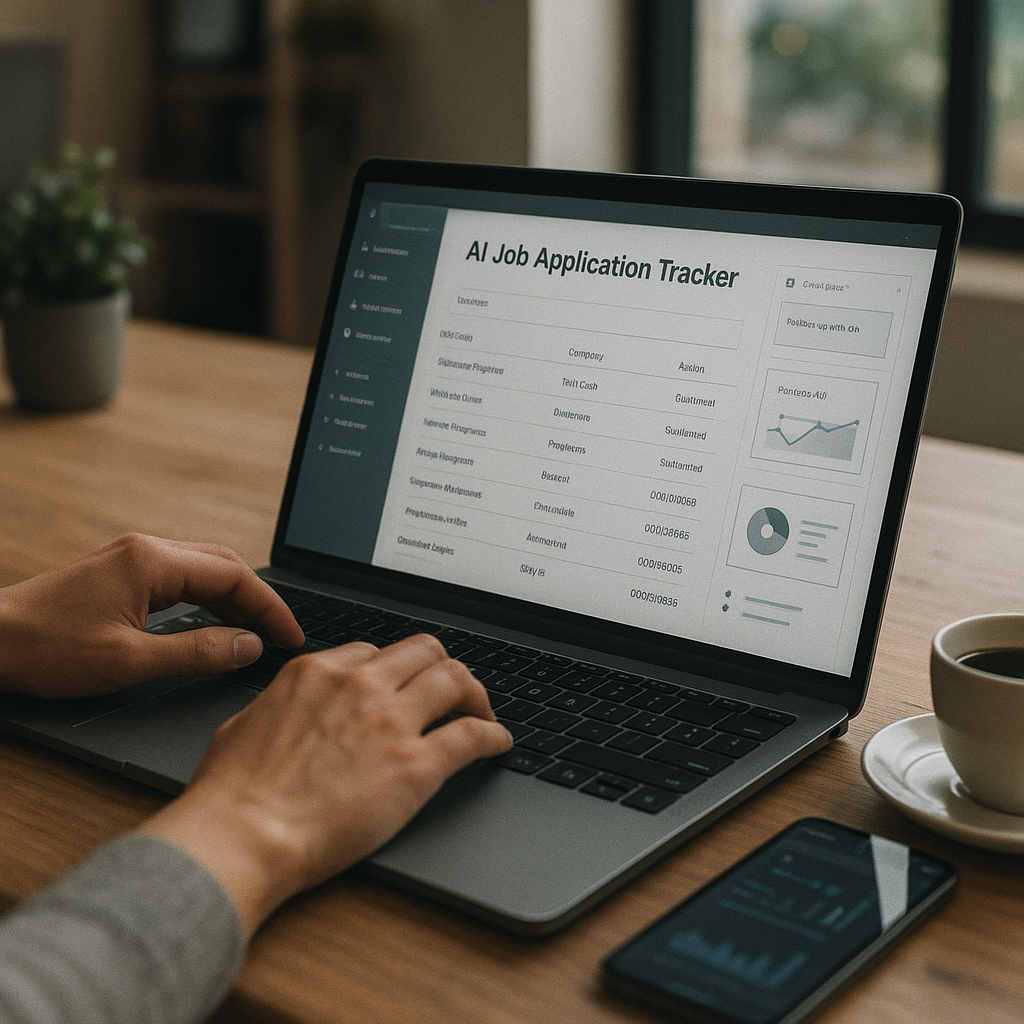
AI job application spreadsheet template (2026)
Stop losing track of roles, follow-ups, and recruiter replies. This guide includes an AI job application spreadsheet template you can copy, plus simple formulas and AI prompts to prioritize applications and improve response rates.

Stop losing track of roles, follow-ups, and recruiter replies. In 2026, job searching is less about “applying to more” and more about running a tight process: tracking every touchpoint, tailoring faster, and following up on time. This guide includes an ai job application spreadsheet template you can copy, plus simple formulas and AI prompts to prioritize applications and improve response rates—without turning your job hunt into a second full-time job.
Why you need an AI job application spreadsheet template in 2026 (not “just a tracker”)
Most job seekers don’t lose opportunities because they aren’t qualified. They lose them because the workflow breaks:
- A great role gets buried in bookmarks.
- A recruiter replies… and you respond three days later.
- You apply, but don’t follow up.
- You tailor one resume too late, or you tailor the wrong parts.
Meanwhile, hiring teams in 2026 are using faster, more automated pipelines: ATS filters, structured screening, and standardized scorecards. That means your advantage comes from speed + relevance + consistency—and a spreadsheet system that uses AI to help you decide what to do next.
A good AI-enhanced job application sheet should do four things:
1. Keep every application and contact in one place
2. Tell you what to do today (follow up, tailor, network, move on)
3. Score and prioritize roles based on fit and urgency
4. Generate better messages and tailoring prompts quickly
Copy/paste: AI job application spreadsheet template (Google Sheets + Excel)
Below is a practical, 2026-ready ai job application spreadsheet template layout. You can copy these columns into Google Sheets or Excel and start immediately.
Sheet 1: Applications (main tracker)
Recommended columns (in order):
1. Company
2. Role Title
3. Location / Remote
4. Job Link
5. Source (LinkedIn, company site, referral, recruiter, etc.)
6. Date Found
7. Date Applied
8. Status (To Apply, Applied, Recruiter Screen, HM Screen, Interview, Offer, Rejected, On Hold)
9. Next Action (Tailor resume, Follow up, Schedule call, Send thank-you, etc.)
10. Next Action Date
11. Priority Score (0–100)
12. Fit Score (0–10)
13. Comp Range
14. Work Auth / Visa
15. Hiring Manager
16. Recruiter Name
17. Recruiter Email / LinkedIn
18. Referral / Warm Contact
19. Last Contact Date
20. Follow-up Due? (Yes/No)
21. Follow-up # (1,2,3…)
22. ATS Keywords Missing (short list)
23. Tailoring Notes (what you changed)
24. Interview Notes
25. Outcome Notes (reason rejected, feedback, etc.)
Data validation (dropdowns) to add immediately:
- Status dropdown (To Apply, Applied, Screen, Interview, Offer, Rejected, On Hold)
- Source dropdown
- Location / Remote dropdown (Onsite, Hybrid, Remote)
Sheet 2: Contacts (your networking CRM)
Columns:
- Name
- Company
- Title
- Connection Type (Recruiter, Hiring Manager, Employee, Alum, etc.)
- Where you met
- Link (LinkedIn)
- Email
- Last Message Date
- Next Follow-up Date
- Notes
- Related Roles (link to rows or role names)
Sheet 3: Resume + Keywords
Columns:
- Role Family (e.g., Data Analyst, Product Manager)
- Master Resume Link
- Tailored Resume Link
- Top Skills for This Track
- Keyword Bank (paste from job posts)
- Stories/STAR Examples (links or short bullets)
The formulas that make your spreadsheet “AI-powered” (without being complicated)
You don’t need advanced automation to get big results. These formulas turn your tracker into a decision engine.
1) Follow-up due flag (simple + reliable)
Goal: show “Yes” when it’s time to follow up.
Assumptions:
- Status is in column H
- Last Contact Date is in column S
- Date Applied is in column G
Rule of thumb (2026-friendly):
- Follow up 5 business days after applying if no reply.
- Follow up 3 business days after a recruiter message if you’re waiting.
Formula idea (Google Sheets):
excel=IF(OR(H2="Rejected",H2="Offer"),"No",
IF(H2="Applied",
IF(TODAY()-G2>=5,"Yes","No"),
IF(OR(H2="Recruiter Screen",H2="HM Screen",H2="Interview"),
IF(TODAY()-S2>=3,"Yes","No"),
"No")))
2) Next action date (auto-schedule)
If you want your sheet to tell you the next date to act:
excel=IF(H2="Applied",G2+5,
IF(OR(H2="Recruiter Screen",H2="HM Screen",H2="Interview"),S2+3,
""))
3) Priority Score (0–100) that reflects reality
A useful score blends fit + urgency + leverage (referral) and avoids wasting time on low-fit roles.
Create these helper columns (optional but powerful):
Fit Score (0–10)— your judgment + AI help
- Urgency (0–10) — deadline soon? hot role? recruiter pinged?
- Leverage (0–10) — referral/warm intro? internal recruiter? strong match?
Then calculate:
excel=ROUND((J26 + K23 + L21)10,0)
Where:
- Fit is weighted most (x6)
- Urgency next (x3)
- Leverage smaller but meaningful (x1)
This produces a 0–100-ish score you can sort by daily.
4) “Today’s to-do list” view (filters)
Create a filter view (or a separate sheet) that shows rows where:
- Follow-up Due? = Yes OR
- Status = To Apply and Priority Score >= 70 OR
- Next Action Date <= TODAY()
That becomes your daily workflow in 10 minutes.
AI prompts to prioritize roles, tailor faster, and improve reply rates
This is where the “AI” part of your ai job application spreadsheet template actually pays off: you use AI on demand to generate outputs you paste back into the sheet.
Prompt 1: Fit scoring (0–10) + missing keywords
Use this after pasting the job description and your resume summary.
Prompt:
You are a recruiter and ATS. Score my fit for this role from 0–10.
Output: (1) Fit score, (2) top 8 keywords/skills the job emphasizes, (3) keywords missing from my resume, (4) 3 bullet suggestions to improve my resume for ATS while staying truthful.
Job description: [paste]
My resume summary + skills: [paste]
Paste the results into:
- Fit Score (0–10)
- ATS Keywords Missing
- Tailoring Notes
Prompt 2: Application prioritization across 10 roles
Paste 5–10 job blurbs (or bullet summaries) and ask AI to prioritize based on your goals.
Prompt:
Rank these roles by priority for me to apply in the next 48 hours.
Criteria (in order): alignment with my target title, transferable skills, compensation, remote preference, growth path, and likelihood of interview.
Output a table: Company | Role | Fit (0–10) | Why | Recommended next action.
My target: [role/industry]
My constraints: [salary, location, visa, remote]
Roles: [paste list]
Use the outputs to set Priority Score, Next Action, and your daily focus.
Prompt 3: High-response recruiter follow-up (short + specific)
Prompt:
Write a concise follow-up message to a recruiter.
Context: I applied on [date]. Role: [title]. Company: [company].
Include: 1 sentence of fit proof (metric-based), 1 question, and a polite close.
Tone: confident, brief, not pushy. 70–110 words.
Track it in:
- Last Contact Date
- Follow-up #
- Outcome Notes
Prompt 4: Interview prep notes tied to the job posting
Prompt:
Create a 10-minute interview prep sheet for this role:
- 5 likely questions
- 3 STAR stories I should prepare (with prompts)
- 5 questions I should ask the interviewer
Job description: [paste]
My background highlights: [paste]
Paste key points into Interview Notes so you don’t scramble later.
Spreadsheet vs AI job tracker tools in 2026: what’s best?
A spreadsheet is flexible, cheap, and fast. But it can also become manual busywork as your search scales. Here’s an honest comparison.
| Option | Best for | Pros | Cons |
|---|---|---|---|
| Google Sheets / Excel (template + prompts) | DIY organizers who want full control | Free/low-cost, customizable, easy sorting and filtering, works offline | Manual updates, hard to keep consistent, no automatic insights, easy to forget follow-ups |
| Notion tracker | People who like dashboards + notes | Great for docs, interview notes, templates, linking pages | Can get complex; scoring + automation still needs setup |
| CRM-style job trackers | Network-heavy job seekers | Better contact management and reminders | May lack ATS/tailoring help; can feel “salesy” |
| Apply4Me (job tracker + AI insights) | Job seekers who want speed + structure | Job tracker, ATS scoring, application insights, auto-apply, mobile + web app, career path planning, interview prep | Less customizable than a spreadsheet; you’ll still want to review before applying |
Honest verdict
If you’re applying to under ~20 roles total, the spreadsheet alone is perfect. If you’re running a broader search (multiple target titles, 30–100 applications, lots of recruiter messages), a dedicated tool can save hours—especially when it adds ATS scoring + application insights and keeps your pipeline clean.
A practical hybrid many job seekers use: spreadsheet for customization + a tool for automation and insights.
How Apply4Me fits into this workflow (without replacing your process)
Mid-search is usually when people burn out: too many tabs, too many “did I follow up?” moments, and inconsistent tailoring. Apply4Me is useful specifically because it tackles the messy middle of the process:
- Job tracker that mirrors your spreadsheet stages (so you don’t lose roles)
- ATS scoring to spot weak matches and missing keywords faster
- Application insights that help you understand what’s working (and what isn’t)
- Auto-apply for roles where speed matters—while you spend your energy on higher-priority, high-fit applications
- Mobile + web app so you can track, follow up, and prep anywhere
- Career path planning to keep your target roles consistent
- Interview prep tools to reduce last-minute scrambling
If you like the spreadsheet structure but want less manual work, this is the type of tool that pairs well with an AI-first workflow.
Step-by-step: Set up your AI job application spreadsheet template in 30 minutes
Step 1) Create the sheet + dropdowns (10 minutes)
- Add the Applications columns from above.
- Set dropdowns for Status, Source, Location / Remote.
- Freeze the header row and turn on filters.
Step 2) Add the 3 key formulas (5 minutes)
- Follow-up Due?
- Next Action Date
- Priority Score
Sort by Follow-up Due? and Next Action Date so your sheet becomes a task list.
Step 3) Define your “two-lane” application strategy (5 minutes)
Split applications into two lanes:
Lane A (High Fit / High Priority):
- Fit score 8–10
- You tailor resume + write a targeted intro line
- You network for a warm intro within 24 hours
Lane B (Good Fit / Speed Apply):
- Fit score 6–7
- Minimal tailoring (keywords + headline)
- Apply fast; follow up once
This prevents spending 45 minutes tailoring a role you shouldn’t be chasing.
Step 4) Add AI prompts to your workflow (5 minutes)
Create a doc or sheet tab named Prompts and paste:
- Fit scoring prompt
- Prioritization prompt
- Recruiter follow-up prompt
- Interview prep prompt
Step 5) Run a weekly review (5 minutes)
Every week, filter your sheet and decide:
- Which 5 roles get Lane A treatment next week?
- Which 10–20 roles get Lane B speed applies?
- Which stale applications get a final follow-up, then archive?
Pro tip: Add a Archive? column and mark “Yes” for anything with:
- 2+ follow-ups and no response after 14 days, or
- status = Rejected/On Hold for 30+ days
Keeping the sheet clean improves decision-making and motivation.
Conclusion: Turn your job search into a system (not a guessing game)
A strong ai job application spreadsheet template doesn’t just store applications—it helps you act faster, follow up on time, and focus effort where it’s most likely to turn into interviews. If you want to keep the structure but cut the manual overhead, use a tool that adds ATS scoring, insights, and automation.
Try Apply4Me free to track every role in one place, get ATS scoring + application insights, and move from “I think I applied” to a clear daily plan in minutes.
Frequently Asked Questions
What should be included in an AI job application spreadsheet template?
At minimum: company, role, link, dates (found/applied/last contact), status, next action, next action date, priority score, and recruiter/contact details. The “AI” part comes from adding fit scoring, keyword gaps, and message prompts to drive decisions—not just logging data.
How often should I follow up after applying in 2026?
A common cadence is 5 business days after applying if you haven’t heard back, then once more about a week later if the role is still open. If a recruiter is already in the loop, follow up sooner—around 3 business days after the last message.
Is a spreadsheet enough, or should I use an app?
A spreadsheet is enough for smaller, focused searches or if you love customizing your workflow. If you’re applying broadly or juggling multiple conversations, an app with reminders, ATS scoring, and application insights can reduce missed follow-ups and help you prioritize faster.
How do I use AI without sounding generic in messages?
Give AI specific inputs: the role, your exact measurable results, and the recruiter’s context—then ask for a short message with one proof point and one question. Always edit the first line and add a human detail (team/product/mission) to avoid copy-paste vibes.

Jorge Lameira
Author