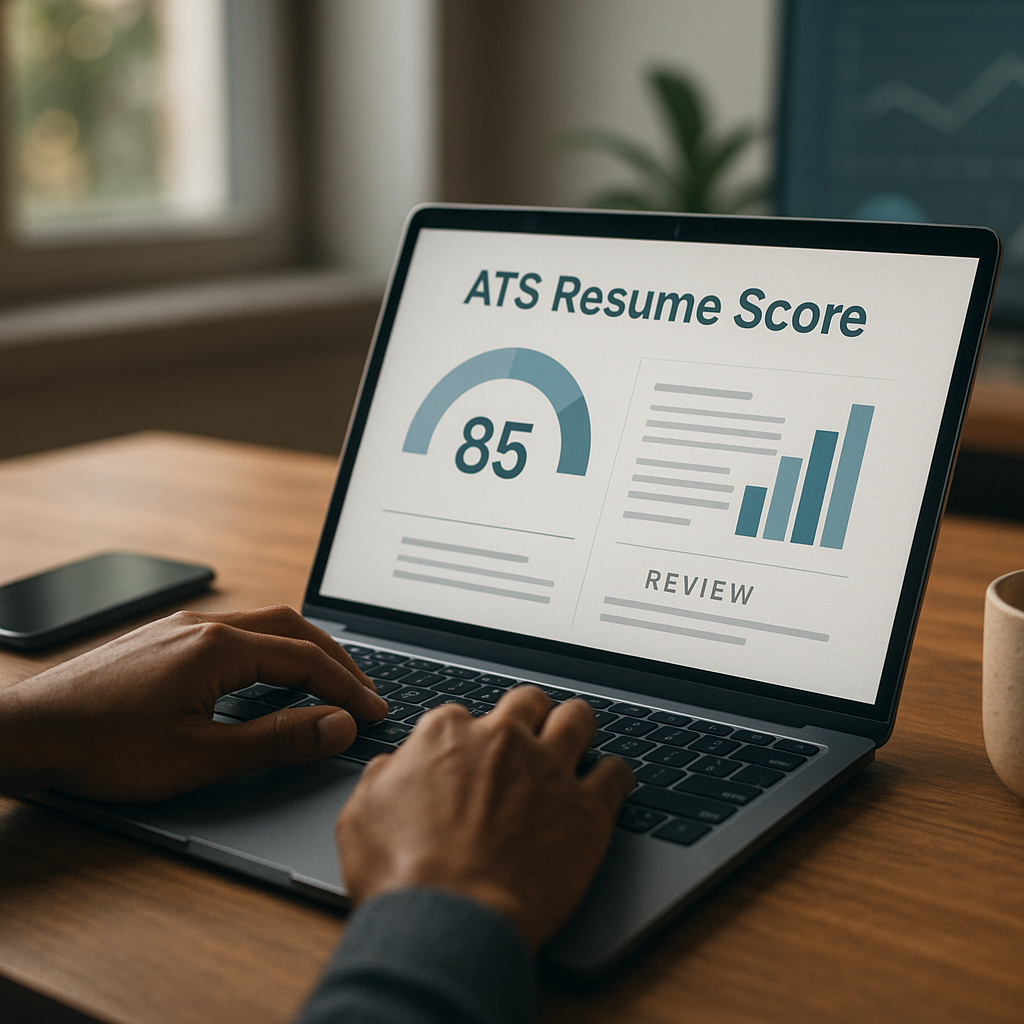
AI job application audit checklist (ATS + recruiter)
Use this ai job application audit checklist to spot the exact gaps that keep your resume, cover letter, and application form from converting into interviews. You’ll get a step-by-step review flow that covers ATS parsing, keyword relevance, recruiter skim signals, and follow-up timing—so every application improves the next.
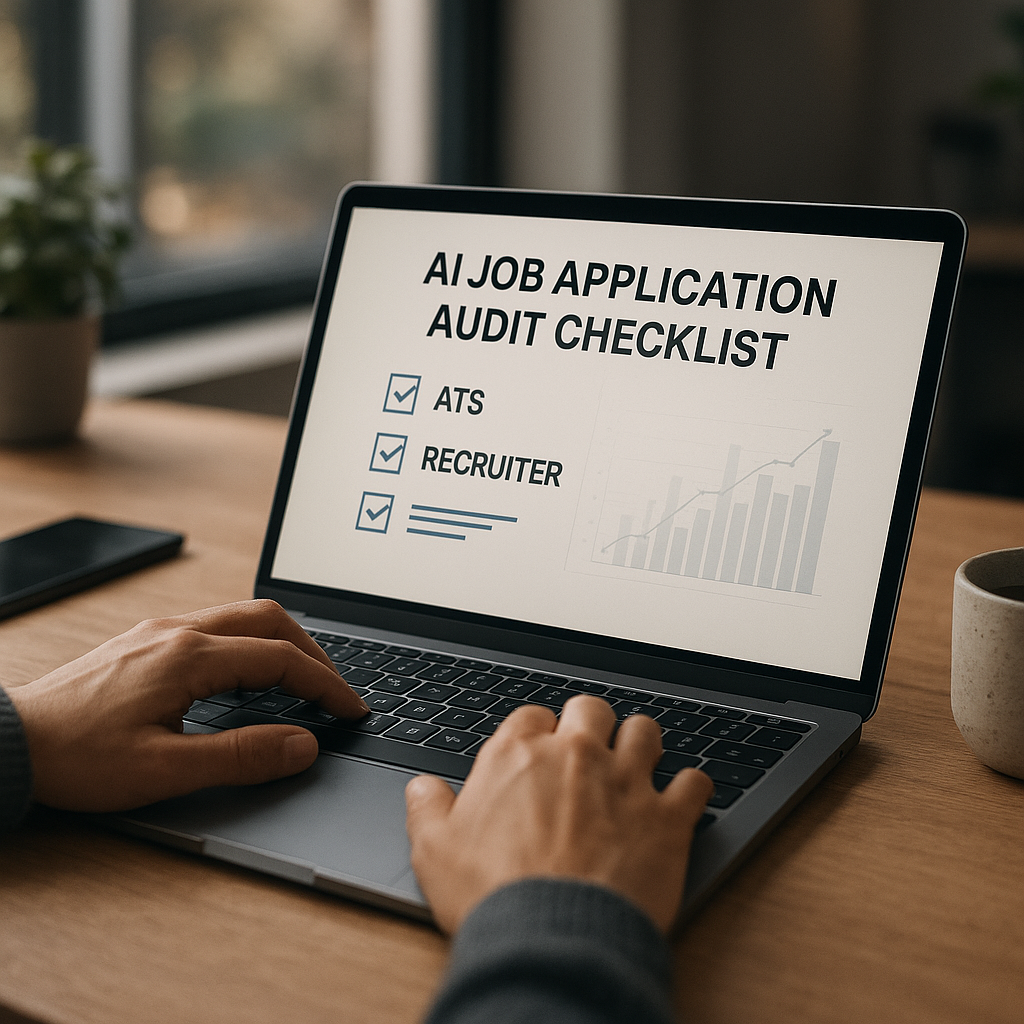
Use this ai job application audit checklist to spot the exact gaps that keep your resume, cover letter, and application form from converting into interviews. You’ll get a step-by-step review flow that covers ATS parsing, keyword relevance, recruiter skim signals, and follow-up timing—so every application improves the next.
In the 2026 job market, the best candidates aren’t always the ones who get interviews; the best packaged candidates do. Many employers now run multi-stage screening (ATS parsing → knock-out questions → AI-assisted recruiter shortlists → hiring manager review). The good news: you can audit your application like a system, fix the bottlenecks, and measurably increase your response rate.
What an ATS and a recruiter are really screening for in 2026
Before you audit, you need the “grading rubric.”
ATS (Applicant Tracking System) focuses on:
- Parsing accuracy: Can it correctly extract your name, contact info, job titles, dates, skills, and education?
- Structured relevance: Do your skills and experience match the job’s requirements in a machine-readable way?
- Completeness: Are required fields filled? Are you eligible (location, work authorization, licensure)?
- Consistency: Do dates, titles, and employers match across resume + application form?
Recruiters focus on (often in a 10–30 second skim):
- Role fit signals: Title alignment, industry context, scope, and seniority match.
- Impact proof: Metrics, outcomes, and credible achievements (not responsibilities).
- Clarity + trust: Easy-to-scan formatting, no red flags, consistent narrative.
- Motivation + match: Why this role/company (especially for competitive openings).
Think of your application as two documents: one for machines (ATS) and one for humans (recruiters). Your audit must satisfy both.
The ai job application audit checklist (ATS + recruiter) you can run in 20 minutes
Use this as your repeatable pre-submit workflow. Run it every time you apply—especially for high-priority roles.
1) ATS parsing audit: “Can the system read me correctly?”
Goal: Zero parsing errors and no missing fields.
Checklist
- Use a single-column layout (most reliable for parsing).
- Avoid tables, text boxes, icons, and graphics for critical info (ATS can misread them).
- Use standard section headers: Summary, Skills, Experience, Education, Certifications, Projects.
- Save as PDF unless the employer requests .docx. If the ATS preview looks broken, switch formats.
- Include your city + state (or region) and work authorization if relevant.
- Put contact info in plain text (no headers/footers).
Quick test (60 seconds):
- Upload your resume to the application portal and open the ATS preview (if available).
- If your job titles/dates are jumbled or sections are missing, fix formatting before you proceed.
Common 2026 parsing failure points
- “Creative” headings (e.g., “Where I’ve Been” instead of “Experience”)
- Two-column resumes (skills on left, experience on right)
- Logos next to employers
- Skills stuffed into a sidebar
2) Keyword relevance audit: “Do I match the job description language?”
Goal: Align your resume to the job’s wording without copying blindly.
Checklist
- Identify the job’s Top 10 hard-skill keywords (tools, platforms, frameworks, certifications).
- Identify Top 5 responsibility keywords (e.g., “stakeholder management,” “forecasting,” “incident response”).
- Mirror the employer’s preferred phrasing where accurate (e.g., “customer lifecycle” vs. “customer journey”).
- Place keywords in context (a bullet with outcome), not just in a skills list.
Actionable method (5 minutes):
1. Paste the job description into a notes doc.
2. Highlight repeated terms and “must-have” requirements.
3. On your resume, ensure those terms appear in:
- Skills section (as a clean list)
- Most recent 1–2 roles (in bullets showing impact)
- Projects (if you’re pivoting or early-career)
Example (weak → strong keyword integration):
- Weak: “Used dashboards to report performance.”
- Strong: “Built Looker dashboards to track conversion rate and CAC, reducing reporting time by 35% for weekly exec reviews.”
3) Recruiter skim audit: “Will a human ‘get it’ in 15 seconds?”
Goal: Instant clarity on what you do, what level you are, and why you’re credible.
Checklist
- Your top third includes:
- A clear target title (aligned with the posting)
- A 1–2 sentence summary with niche + scope
- 3–6 skills that match the role
- Your experience bullets follow a simple pattern:
- Action + tool + scope + result
- Prioritize the most relevant accomplishments in each role (don’t list everything).
- Keep bullets to 1–2 lines where possible.
- Use numbers wherever reasonable (even ranges).
High-converting bullet formulas (steal these)
- “Led X to achieve Y, improving Z by N%.”
- “Built/implemented X using Y, resulting in $N impact / N hours saved / N% lift.”
- “Partnered with A/B to deliver X under constraint Y, reducing risk/cycle time by N%.”
Recruiter trust signals in 2026
- Specific tooling + scope (“Snowflake + dbt + Airflow” beats “data tools”)
- Proof of cross-functional work (Product, Sales, Legal, Security)
- Clean timeline and titles (no unexplained gaps, consistent dates)
- Links that add proof (portfolio, GitHub, case study, LinkedIn—where appropriate)
4) Cover letter audit (only when it increases odds)
Goal: Use a cover letter as a targeting asset, not a generic template.
Not every application needs a cover letter. In 2026, it helps most when:
- You’re pivoting (industry/role change)
- You’re relocating or need to explain work authorization
- You have a non-linear background
- The role is mission-driven or communication-heavy
Checklist
- First paragraph: role + why this company/team (1–2 sentences).
- Middle: 2 mini “proof stories” that map directly to the job requirements.
- End: availability + enthusiasm + one line that makes scheduling easy.
Mini proof story template
- “When I joined X, the team struggled with Y. I did Z using A, which resulted in B.”
5) Application form audit: “Am I creating contradictions?”
Goal: Your form data must match your resume—because systems and recruiters compare them.
Checklist
- Match job titles exactly as on resume (or explain variants in parentheses).
- Match employment dates (month/year).
- Don’t skip optional fields that improve matching (skills, LinkedIn, portfolio).
- For compensation questions, avoid underselling:
- Use “Open to market rate” when allowed, or a researched range.
- For relocation/on-site/hybrid:
- Answer clearly; ambiguity creates friction.
Knock-out question prep
Many rejections happen here. Before applying, confirm:
- Required certifications/licensure
- Location/time zone constraints
- Security clearance needs
- Degree requirements (if strict)
6) Follow-up timing audit: “Did I build a simple second touch?”
Goal: Increase your odds without spamming.
Checklist
- If you have a recruiter/hiring manager name:
- Send a short follow-up 2–4 business days after applying.
- If you don’t:
- Connect with 1–2 relevant employees on LinkedIn (team-adjacent, not random).
- Reference something concrete:
- A product release, company initiative, or a job requirement you match strongly.
Follow-up message (copy/paste)
Hi [Name]—I applied for the [Role] and wanted to share a quick highlight: I recently [did X] using [tools] and improved [metric] by [result]. If helpful, I can send a 1-page overview of how I’d approach [job problem]. Thanks for your time.
How to use AI to audit your application (without creating “AI-sounding” red flags)
AI is great for diagnosis and rewriting, but it can also create generic, over-polished language that recruiters spot instantly. Use AI like a reviewer, not a ghostwriter.
Best AI prompts for auditing (specific and safe)
Paste your resume + the job description, then use prompts like:
1) ATS + keyword audit
- “List the top 15 keywords from this job description and mark which ones appear in my resume. Suggest 8 resume edits that add missing keywords naturally in context.”
2) Recruiter skim test
- “Pretend you’re a recruiter. In 20 seconds, what role level do you think I’m at, and what are the top 3 strengths/concerns from my resume? Be blunt.”
3) Bullet rewrites with metrics
- “Rewrite these 6 bullets to be outcome-based. Keep them truthful, avoid buzzwords, and use numbers where possible. Ask me clarifying questions if a metric is missing.”
4) Cover letter proof stories
- “Extract 2 experiences from my resume that match the top requirements and draft two short proof paragraphs (max 4 sentences each).”
Anti-“AI voice” checklist
- Remove clichés: “fast-paced,” “results-driven,” “synergy,” “go-getter”
- Prefer concrete nouns: tools, deliverables, artifacts, stakeholders
- Keep sentence length varied (not uniformly polished)
- Use fewer adjectives and more facts
Tools that help you run an application audit faster (and what they’re best at)
If you’re applying to multiple roles weekly, tools can reduce friction—especially for tracking, scoring, and iteration.
| Tool type | Best for | Pros | Cons | Who it’s ideal for |
|---|---|---|---|---|
| ATS resume scanners / scorers | Keyword and structure checks | Fast feedback, highlights missing skills | Can over-emphasize keywords; not always recruiter-realistic | High-volume applicants needing quick iteration |
| Grammar/style tools | Clarity and typos | Catches errors, improves readability | May “flatten” your voice | Anyone polishing final drafts |
| Job trackers | Keeping momentum | Deadlines, statuses, follow-ups, notes | Requires consistency to maintain | People juggling many applications |
| Auto-apply tools (use carefully) | Speed | Saves time on repetitive forms | Risk of mis-targeted applications if not configured well | Roles with consistent requirements |
A practical option that combines multiple pieces of this workflow is Apply4Me: it includes a job tracker, ATS scoring, and application insights so you can see what’s working across roles. If you’re applying at volume, features like auto-apply (with targeting controls), mobile + web access, career path planning, and interview prep can help you turn your audit into a repeatable system instead of a one-off effort.
Step-by-step: Run the checklist on one job (a repeatable 7-step workflow)
Use this exact flow before every “priority” application.
Step 1: Build a mini “requirements map” (3 minutes)
Create a quick list:
- Must-haves (5): required tools, certifications, years, domain
- Nice-to-haves (5): preferred tools, extra domain experience
- Outcomes (3): what success looks like in the role (from the description)
Step 2: Tailor your headline and summary (2 minutes)
- Replace your headline with the job’s target title (truthfully).
- Update summary with the niche + scope + proof.
Example
- “Product Analyst | Lifecycle + Experimentation | 5+ years improving activation and retention”
Step 3: Match skills section to the posting (2 minutes)
- Reorder skills so the most relevant appear first.
- Add missing skills only if you actually have them.
Step 4: Swap in 2–3 bullets that match the job’s outcomes (7 minutes)
For your most recent role, rewrite or reorder bullets so the first ones match the role’s priorities.
Example outcome mapping
- Job needs: “Reduce churn, run experiments, stakeholder management”
- Your top bullets should include: retention metrics, A/B testing, cross-functional work
Step 5: Run the ATS preview test (1 minute)
Upload → preview → confirm formatting and fields.
Step 6: Audit the application form for consistency (3 minutes)
- Titles, dates, location, links, and education must match the resume.
- Answer knock-out questions carefully.
Step 7: Set your follow-up reminder immediately (1 minute)
Add a calendar reminder for 2–4 business days after submission.
If you’re using a tracker (spreadsheet or a platform like Apply4Me), log:
- Job title + link
- Version name (e.g., “PMM_resume_v3_fintech”)
- Keywords added
- Follow-up date
That tracking is what turns “applying” into “iterating”—and iteration is how you improve response rate.
Conclusion: turn every application into a measurable improvement
A strong application in 2026 isn’t just “a good resume.” It’s a cleanly parsed document, aligned keywords, obvious impact, consistent form data, and a follow-up plan. When you run an audit, you stop guessing—and you start fixing the exact stage where your candidacy drops off.
Try Apply4Me free to track applications, get ATS scoring and insights, and tighten your follow-up timing in one place—so your next application is stronger than your last (and it takes minutes to get started).
Frequently Asked Questions
What is an ai job application audit checklist?
An ai job application audit checklist is a repeatable set of steps to review your resume, cover letter, and application form for both ATS compatibility and recruiter appeal. It helps you find gaps (parsing, keywords, clarity, consistency, follow-up) before you hit submit.
How many keywords should I match in a job description?
Aim to cover the core requirements: the top tools, skills, and responsibilities that appear repeatedly in the posting. Quality matters more than quantity—include keywords where they truthfully reflect your experience, especially in impact-driven bullets.
Should I use a PDF or DOCX for ATS in 2026?
Many ATS platforms handle PDFs well, but some still parse DOCX more reliably. If the employer provides an ATS preview and your PDF looks scrambled, switch to DOCX; otherwise, a clean, single-column PDF is often fine.
Do follow-ups still work, or do recruiters ignore them?
Follow-ups can work when they’re specific and timed well—typically 2–4 business days after applying. A short message that highlights one quantified accomplishment and maps to the job’s needs is more effective than a generic “checking in.”

Jorge Lameira
Author