ATS resume score: what it means & how to improve
Confused by your ATS resume score and what recruiters actually see? This guide explains what an ATS resume score measures, what common issues drag it down, and the highest-impact fixes you can make before you apply.
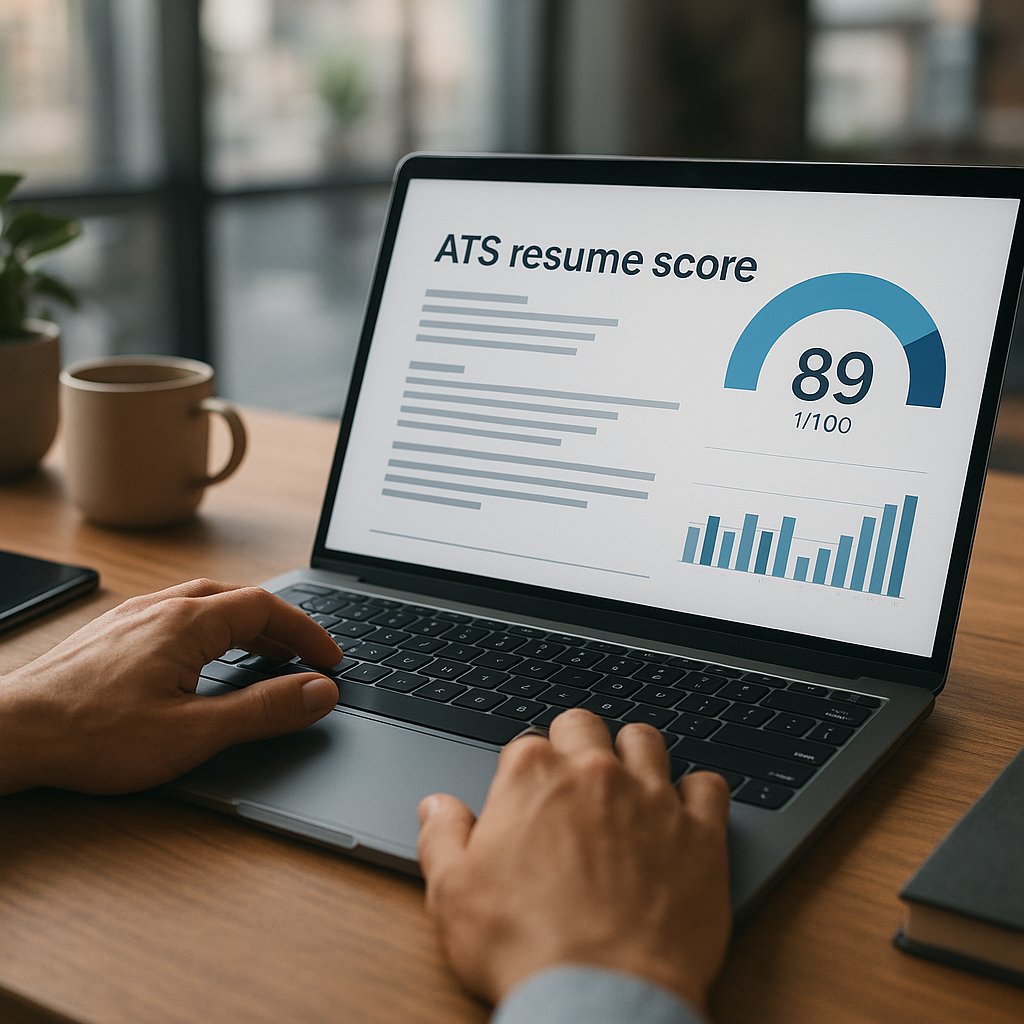
Confused by your ats resume score and what recruiters actually see? You’re not alone. In 2026, most job seekers apply online, and many employers use applicant tracking systems (ATS) to sort, rank, and route resumes before a human ever reads them. That’s why a low score can feel like you’re “qualified but invisible.”
This guide breaks down what an ATS resume score typically measures, what common issues drag it down, and the highest-impact fixes you can make—fast—before you apply.
What is an ATS resume score (and is it “real”)?
An ATS resume score is a numeric or graded estimate of how well your resume matches a specific job posting as interpreted by software. It’s usually based on factors like keyword overlap, skills alignment, job title match, and formatting readability.
Important nuance: there is no universal score.
Different ATS platforms, employer configurations, and screening workflows score and rank candidates differently. Some companies never show a “score” to recruiters at all—only a shortlist, match labels (e.g., “strong match”), or filters (e.g., “has Salesforce”).
What it does represent in most systems:
- Relevance: Does your resume contain the skills, tools, and experience the job asks for?
- Parsability: Can the system cleanly extract your job titles, dates, companies, and skills?
- Fit signals: Are your seniority level, years of experience, and core responsibilities aligned?
What it doesn’t perfectly represent:
- Your potential, personality, or soft skills
- Context behind career changes
- Portfolio strength (unless linked and reviewed)
- Human judgment (which comes later—if you get through)
What recruiters actually see in ATS (and how your score affects visibility)
Recruiters don’t usually stare at one magic number and decide your fate. In many workflows, the ATS is used to:
1. Parse your resume into fields (title, employer, dates, education, skills)
2. Apply knockout filters (location, work authorization, required certification)
3. Rank or group candidates by match strength or keyword relevance
4. Surface highlights (skills found, recent titles, most relevant experience)
5. Track stage movement (screening → interview → offer)
A “low score” often correlates with one of these practical problems:
- Your resume isn’t being ranked high enough to be seen early.
- Your resume isn’t being parsed correctly, so key info is missing.
- You’re failing filters because required items aren’t clearly stated.
In high-volume roles (customer success, project management, data analyst, operations, sales), recruiters may review only the first batch of strongest matches. If you’re ranked lower—even if qualified—you can get buried.
Why your ATS resume score is low: the 9 most common causes
1) You’re missing “must-have” keywords (or using the wrong versions)
ATS matching is literal. If the job asks for “SQL” and you wrote “Structured Query Language” only, some systems won’t connect the dots.
Fix: Include both versions where natural:
- “SQL (Structured Query Language)”
- “HubSpot CRM (HubSpot)”
2) Your resume isn’t tailored to the job’s priority skills
A generic resume spreads focus across everything you’ve done, not what this role needs.
Fix: Mirror the job’s top skills in:
- Your Professional Summary
- Your Skills section
- Your most recent 1–2 roles (bullets)
3) Your job title doesn’t match common titles for the role
If the role is “Product Manager” and your title is “Product Lead (Internal Tools),” the ATS might not map it well.
Fix: Keep your official title, but add a clarifier:
- Product Lead (Product Manager – Internal Tools)
Only do this if it’s honest and accurate.
4) Formatting prevents clean parsing
Columns, text boxes, icons, headers/footers, and some chart-style skill bars can break parsing.
Fix: Use a single-column layout and standard headings:
- “Experience”
- “Education”
- “Skills”
- “Certifications”
5) Your skills are buried in paragraphs
ATS can find skills in paragraphs, but recruiters also scan a dedicated skills section.
Fix: Add a clean skills block with 10–20 relevant skills (not 60).
6) You overuse buzzwords instead of concrete tools and outcomes
“Hardworking team player” doesn’t help matching. Tools and measurable outcomes do.
Fix: Swap buzzwords for specifics:
- “Managed stakeholder communications” → “Led weekly stakeholder updates across Product, Legal, and Sales (12+ stakeholders)”
7) Dates and employment details are inconsistent
If the ATS can’t interpret your dates, it may misread your tenure.
Fix: Use consistent date formatting:
- “Jan 2023 – Jun 2025” (not “1/23–6/25” in one place and “2023–2025” in another)
8) You’re applying slightly outside your level—and the resume doesn’t bridge the gap
If the role is senior and your bullets don’t show ownership, strategy, or scope, the system may rank you lower.
Fix: Add senior-level signals:
- Budget ownership
- Cross-functional leadership
- Metrics, scale, complexity
- Process improvements
9) You’re missing required credentials or they’re not spelled out
If the job requires “PMP” and you only wrote “Project Management Professional,” filters might miss it.
Fix: Use both:
- “PMP (Project Management Professional)”
How to improve your ATS resume score (highest-impact fixes first)
Step 1: Extract the “keyword shortlist” from the job description (10 minutes)
Copy the job description into a doc and highlight:
- Tools/Platforms (e.g., Salesforce, Jira, Tableau, AWS)
- Core skills (e.g., forecasting, stakeholder management, SQL)
- Deliverables (e.g., dashboards, QBRs, roadmaps, SOPs)
- Role-specific verbs (e.g., implement, analyze, negotiate, automate)
Now prioritize the top 12–20 items that appear repeatedly or are listed under “Requirements.”
Step 2: Align your top-third (Summary + Skills) to the job (15 minutes)
Recruiters and ATS both “read” the top of the resume heavily.
Good summary formula (3 lines):
- Target role + years + domain
- 2–3 specialty skills from the posting
- Proof: one metric or signature outcome
Example (Data Analyst posting emphasizing SQL + dashboards + stakeholders):
Data Analyst with 4+ years supporting GTM and Operations teams. Advanced in SQL, Looker, and automated reporting workflows; known for translating stakeholder needs into self-serve dashboards. Reduced weekly reporting time by 35% and improved pipeline visibility across Sales leadership.
Skills section (example):
- SQL, Looker, Tableau, Excel (Power Query), Data Modeling
- Stakeholder Management, KPI Design, Forecasting, A/B Testing
- ETL Basics, Data Quality Checks, Documentation
Step 3: Rewrite your most recent role bullets to mirror the job’s language (30–45 minutes)
ATS scoring improves when the job’s “critical terms” appear in context, especially under recent roles.
Use this bullet structure:
- Action + What + Tool + Outcome (metric)
Before:
- Responsible for dashboards and reports.
After:
- Built and maintained Looker dashboards for Sales leadership, tracking pipeline, conversion, and CAC, improving weekly forecasting accuracy by 12%.
Aim for 6–8 bullets in your most recent role, and ensure at least 50% are relevant to the target job.
Step 4: Fix formatting for parsing (10 minutes)
Use these safe rules:
- Single column
- No text boxes, no icons, no headshot
- Standard fonts (Calibri, Arial, Times, Helvetica)
- Clear headings (“Experience,” “Education,” “Skills”)
- Submit as PDF or .docx depending on employer instructions (if unsure, .docx is often safest for parsing)
Step 5: Add a “Tools/Tech” line if the role is technical (5 minutes)
This is a quick match booster.
Example:
Tools: Jira, Confluence, Salesforce, HubSpot, GA4, Looker, SQL, Excel
Step 6: Include the right keywords without keyword stuffing (ongoing)
Keyword stuffing can backfire with recruiters. Keep it natural by using:
- Skills list (compact)
- Bullets (contextual)
- Projects (if applicable)
- Certifications (exact names)
A good rule: if you claim a tool, show where you used it.
Quick ATS self-check: 12-point resume score audit (copy/paste)
Use this as a pre-apply checklist:
1. Target job title appears near the top (summary or headline)
2. Required certifications are present and spelled exactly as in posting
3. Skills section includes the top 10–15 relevant skills
4. The same tool names appear in experience bullets
5. Recent role bullets include measurable outcomes (%, $, time saved, volume)
6. Dates are consistent and easy to parse
7. Company names and job titles are on separate lines (clear structure)
8. No tables/text boxes/graphics that could break parsing
9. File name is professional: FirstName_LastName_Role.pdf
10. Location/work authorization (if needed) is clearly stated
11. Keywords match your actual experience (no exaggeration)
12. Resume length matches level (1 page early career; 2 pages for experienced)
Tools that help you improve your ATS resume score (honest comparison)
You can do all of the above manually. But if you’re applying to multiple roles, tools can speed up tailoring, scoring, and tracking.
Here’s a practical comparison of common options job seekers use:
| Tool type | Best for | Pros | Cons |
|---|---|---|---|
| Manual tailoring (Docs/Word) | 1–5 applications/week, highly targeted roles | Maximum control; no risk of generic wording | Time-consuming; easy to miss keywords; no scoring feedback |
| Resume scanners / keyword checkers | Quick gap spotting vs job description | Fast; highlights missing terms | Quality varies; can encourage keyword stuffing |
| AI writing assistants | Rewriting bullets and summaries | Saves time; helps with phrasing | Needs supervision; may invent details if you’re not careful |
| Job search platforms with ATS scoring + workflow | Applying consistently and tracking progress | Centralized: scoring, tailoring, tracking, analytics | Some tools focus only on resumes and not end-to-end applying |
Where Apply4Me fits (contextual, not hype)
If your biggest problem is spending hours tailoring and still not knowing whether your resume is competitive, Apply4Me is designed to reduce that uncertainty and friction. It includes ATS scoring plus application insights/analytics and a job tracker, so you can see what you applied to and what’s working—without losing threads across tabs and spreadsheets.
And if you’re applying at volume, Apply4Me’s Auto-Apply can:
- Find and match jobs to your profile, skills, and preferences
- Adapt/tailor your CV to each matched job
- Generate a tailored cover letter per application
- Submit applications automatically (with optional review-before-send)
- Track every auto-applied job so nothing is duplicated or lost
That combination—scoring + tailoring + tracking—maps closely to what actually moves the needle on ATS outcomes: relevance, consistency, and speed.
The fastest way to raise your ATS resume score for each application (15–25 minutes)
If you want a repeatable system that works in the 2026 market, use this mini-workflow:
1) Create a “master resume” (one-time setup)
Include everything: all roles, projects, tools, metrics. This is your source document.
2) For each job, tailor only 3 sections
You’ll get most of the scoring benefit without rewriting your whole life story:
- Headline/Summary: match the role title + 2–3 priority skills
- Skills: reorder so job-critical skills are first
- Most recent role: update 3–5 bullets to mirror the posting
3) Use a keyword “swap list” (so you don’t miss synonyms)
Build a personal dictionary like:
- “Stakeholder management” ↔ “cross-functional communication”
- “Roadmap” ↔ “product strategy”
- “Customer retention” ↔ “churn reduction”
- “ETL” ↔ “data pipelines”
Then choose the phrasing that appears in the posting.
4) Add one proof metric if you don’t have one
No metrics? Create reasonable operational metrics based on scope:
- Volume: “Supported ~40 tickets/week”
- Time: “Reduced onboarding from 10 days to 6”
- Quality: “Improved SLA compliance from 82% to 94%”
- Revenue: “Influenced renewals for ~$300K book”
Keep it truthful—ATS may get you seen, but interviews verify everything.
Conclusion: score higher, get seen sooner, and apply with less stress
An ATS resume score isn’t a judgment of your worth—it’s a signal of how well your resume matches a specific posting and how easily software can read it. The fastest improvements come from (1) tailoring your top-third, (2) mirroring priority keywords in recent experience, and (3) using ATS-safe formatting.
If you want a quicker, more structured way to improve match strength while staying organized, try Apply4Me free to check your ATS scoring, tailor your CV to roles you’re targeting, and track every application in one place—so you can apply confidently without wasting hours.
Frequently Asked Questions
What is a good ATS resume score?
There isn’t a universal benchmark because each ATS and employer scores differently. Practically, you want your resume to strongly match the role’s must-have skills and titles, and to be parsed cleanly—those factors are what typically push you into the “top match” group.
Can ATS reject my resume automatically?
Some systems apply automatic filters (like work authorization, location, certification, or years of experience) that can effectively screen people out. More often, ATS ranks candidates, and recruiters review the highest matches first.
Does using a PDF hurt my ATS resume score?
It depends on the employer’s system. Many ATS tools parse PDFs fine, but some handle .docx more reliably—especially if your PDF has complex formatting. If the application doesn’t specify, a clean .docx is often the safest choice.
How often should I tailor my resume to improve ATS results?
Ideally, for every role you’re serious about. Even 15–25 minutes of tailoring (summary, skills order, and a few bullets) can significantly improve relevance and increase the odds your resume gets surfaced to a recruiter.

Jorge Lameira
Author