AI Skills-Based Resume: How to Turn Your Projects, Micro-Credentials & GitHub Into a Recruiter-Ready Skills Profile
Skills-based hiring is accelerating—but most resumes still read like job descriptions. This guide shows you how to convert real proof (projects, certifications, courses, GitHub, and measurable outcomes) into a skills-first resume structure that recruiters and ATS can understand fast.
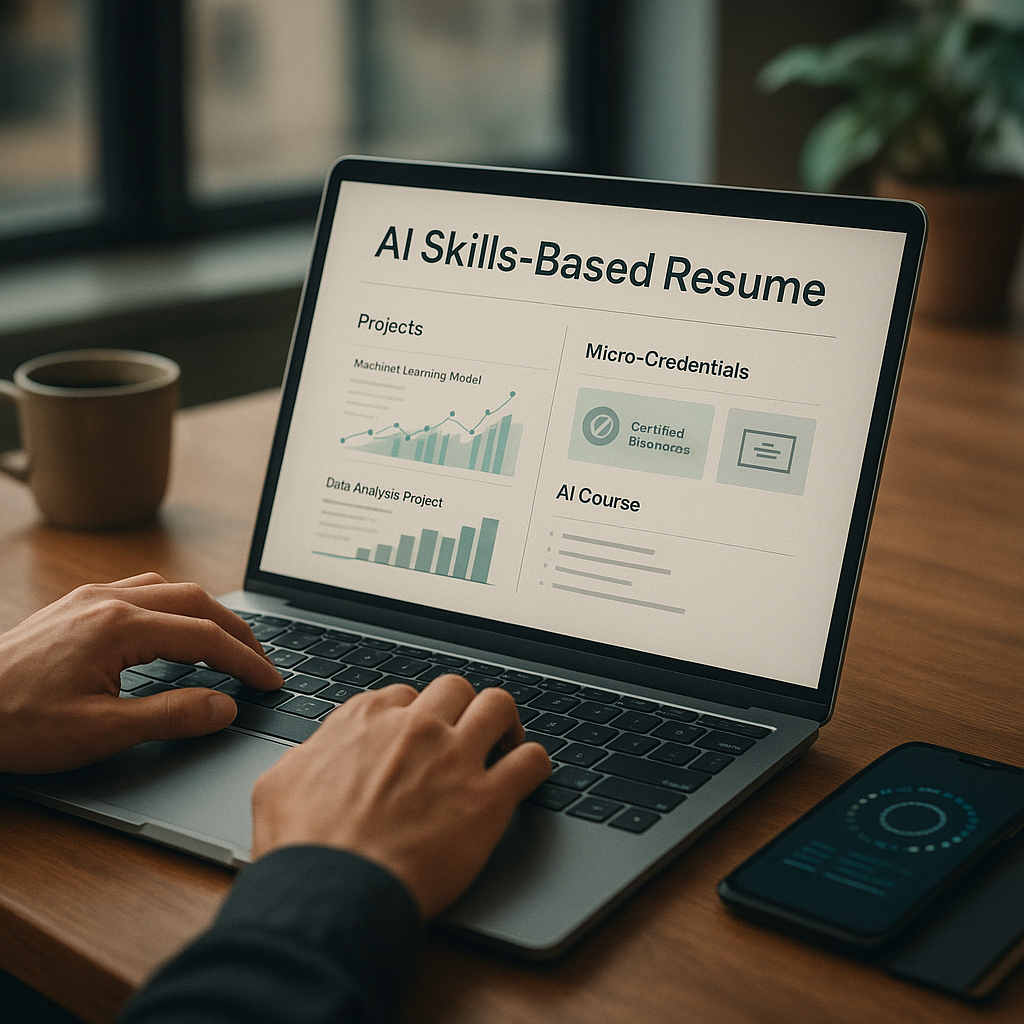
Skills-based hiring is accelerating in 2025—but most resumes still read like job descriptions. If you’re applying with lines like “Responsible for reporting and analysis” or “Worked on machine learning models,” you’re blending into the crowd. Recruiters and ATS tools don’t reward vague responsibilities; they reward verifiable skills + proof + outcomes that map cleanly to the role.
This guide shows you how to convert real proof—projects, micro-credentials, courses, GitHub, and measurable results—into a skills-first resume that gets understood in 10–20 seconds by a recruiter and parsed accurately by ATS.
Why Skills-Based Hiring Is Winning in 2025 (And What Recruiters Actually Scan For)
The resume “meta” has changed. Companies are under pressure to fill roles faster, reduce mis-hires, and broaden candidate pools—so they’re leaning into skills signals that are easier to validate than job titles.
Here’s what’s happening in 2025:
- ATS and screening tools increasingly score skill-match, not just keywords. Many systems now infer skills from project descriptions, links, and credential metadata—not only job titles.
- Shorter recruiter review time is still real. Internal recruiting teams commonly spend under 30 seconds on an initial resume pass, often closer to 10–20 seconds when applicant volume is high.
- Portfolios and GitHub matter beyond software roles. Analysts, marketers, product managers, and operations candidates can show proof through dashboards, experiments, process improvements, automations, and documentation.
Recruiters typically scan for:
1. Role fit (Do you match this job’s skill cluster?)
2. Proof (Can you demonstrate those skills with deliverables?)
3. Impact (Did your work change a metric or outcome?)
4. Credibility signals (recognized tools, micro-credentials, public work, or internal adoption)
If your resume is mostly responsibilities, you’re forcing the recruiter to guess your skill level. A skills-based resume makes it obvious.
Build a “Recruiter-Ready Skills Profile”: The 6-Part Structure That Works in 2025
A skills-first resume isn’t just a list of skills. It’s a system that connects skills → evidence → outcomes. The most effective structure in 2025 looks like this:
1) Headline + Skill Identity (1–2 lines)
This replaces the old objective statement.
Example (Data Analyst):
Data Analyst | SQL • Python • Looker • Experimentation | Turns messy data into revenue insights
Example (Project Manager):
Project Manager | Agile • Stakeholder Management • Jira • Process Optimization | Delivers faster cycle time + clearer execution
Why this works: recruiters see your “skill cluster” immediately.
2) Skills Snapshot (10–16 skills, grouped by category)
Your skills section should be scannable, role-specific, and mirrors the job description (without copying blindly).
Better than a flat list: group skills into 3–4 categories.
Example:
- Analytics: SQL, Python (Pandas), A/B Testing, Cohort Analysis
- BI & Visualization: Looker, Tableau, Power BI, Data Storytelling
- Data Ops: dbt (basic), Git, Data Quality Checks
- Business: KPI Design, Stakeholder Communication, Requirements Gathering
2025 rule: Include only skills you can prove with a project, credential, or bullet. If you can’t back it up, it becomes a risk.
3) Proof-of-Skills Section (The secret weapon)
Most resumes bury proof inside job bullets. In 2025, add a dedicated section:
“Selected Projects” or “Skills Proof (Projects & Impact)”
This is where you turn GitHub, course projects, freelance work, and internal wins into recruiter-friendly evidence.
Template:
- Project Name (Skill Cluster) — Tool stack
Outcome: metric change / improvement
What you did: 2–3 bullets
Links: GitHub / demo / dashboard / write-up
Example (Non-software):
Sales Funnel Optimization (GA4 • SQL • Dashboarding) — GA4, BigQuery, Looker Studio
- Reduced “unknown source” traffic attribution by 21% by fixing UTM governance + channel mapping
- Built a weekly funnel dashboard used by marketing + sales leadership (8 stakeholders)
- Documented tracking plan and QA checklist to prevent regression
Link: Portfolio case study (1-page)
Example (Software/AI):
Customer Support Triage Model (NLP • Evaluation • MLOps basics) — Python, scikit-learn, FastAPI
- Improved ticket routing precision from 0.62 → 0.79 using TF-IDF + linear classifier with threshold tuning
- Created evaluation report (confusion matrix, bias checks) + model card for stakeholder review
- Containerized inference API and added basic CI checks
Link: GitHub repo + README + demo
This section helps recruiters answer: “Can this person actually do the work?”
4) Experience Section (Keep it—just rewrite it for skills + outcomes)
You still need experience, but every bullet should connect a skill to a result.
Use this formula:
Action + Skill/Tool + Scope + Outcome metric
Bad bullet:
- Responsible for reporting and analysis
Better bullet:
- Automated weekly revenue reporting in SQL + Looker, cutting manual work from 4 hours to 30 minutes and improving forecast accuracy discussions with finance
If you don’t have hard metrics, use these outcome types:
- Time saved (hours/week)
- Error reduction
- Cycle time reduction
- Adoption (users, stakeholders, teams)
- Risk reduction (incidents, rollbacks, compliance)
- Revenue impact (even directional or proxy metrics)
5) Micro-Credentials (Make them work harder than a laundry list)
Micro-credentials matter most when they do three things:
1. Map to in-demand skill clusters
2. Demonstrate applied work
3. Are current (last 12–24 months)
Instead of listing 12 certificates, curate 3–6 and connect each to proof.
Better format:
- Google Data Analytics (2025) — Capstone: cohort retention dashboard (link)
- AWS Cloud Practitioner (2024) — Deployed a containerized app demo (link)
- Microsoft Power BI Data Analyst (2025) — Sales performance model + DAX measures (link)
2025 tip: If your credential platform provides a digital badge URL, include it—ATS can parse it, and recruiters can verify it quickly.
6) Links That Recruiters Actually Click (GitHub, Portfolio, LinkedIn)
Your links should be:
- Visible at the top
- Clean (custom URLs)
- Relevant (don’t link to an empty GitHub)
Minimum set:
- Portfolio (Notion, GitHub Pages, Medium, or a simple PDF case study)
- GitHub (if applicable)
Turning GitHub Into Proof (Not a “Code Dump”)
Recruiters don’t have time to reverse-engineer your repo. A strong GitHub presence in 2025 is about clarity, context, and evaluation, not just commits.
What makes a recruiter-ready GitHub repo?
A great README that answers:
- What problem does this solve?
- What data/tools did you use?
- How do I run it or view results?
- What were the outcomes?
- What tradeoffs did you make?
- What would you improve next?
Include:
- Screenshots/GIFs (especially for dashboards/apps)
- A short architecture diagram (even a simple one)
- A “Results” section with metrics (accuracy, latency, cost, time saved)
- Basic tests or linting (signals engineering maturity)
- A LICENSE and clear instructions (signals professionalism)
Example README skeleton (copy/paste)
Project: Support Ticket Classifier
Goal: Route tickets into 6 categories to reduce response time
Stack: Python, scikit-learn, FastAPI
Data: Public dataset + synthetic augmentation (documented)
Results: Macro F1 = 0.78, latency < 120ms per request
How to run:
1. pip install -r requirements.txt
2. python train.py
3. uvicorn app:api --reload
Evaluation: Confusion matrix + failure cases in /reports/
Next: Add drift monitoring + improve minority class performance
Curate your GitHub for job search
Pin 3–6 repos that align with your target role. Archive or hide incomplete experiments if they create noise.
How to Convert Projects & Courses Into Resume Bullets That ATS Understands
Many candidates have projects but describe them like school assignments. Your job is to translate them into business language.
Use this translation map
Course project language → Recruiter language
- “Built a dashboard for a dataset” → “Designed KPI dashboard to monitor X and reduce decision latency”
- “Trained a model” → “Improved classification performance by X using evaluation + iteration”
- “Cleaned data” → “Standardized data pipeline, reducing errors and improving reliability”
Bullet templates for different roles (2025-ready)
Data / Analytics
- Built [dashboard/model] in [tool] to track [KPI], enabling [decision] and improving [metric] by X%
Product / Ops
- Mapped [process] and implemented [change] using [tool/framework], reducing cycle time X% across N stakeholders
Marketing / Growth
- Ran [experiment/campaign] using [platform], improving [conversion/CPA/retention] by X through [insight]
Software
- Shipped [feature/service] in [stack], improving [latency/cost/reliability] by X; added [tests/monitoring] to prevent regressions
Feature Comparison: Skills-Based Resume Tools in 2025 (What Helps vs. What’s Hype)
A lot of “AI resume tools” in 2025 are good at rewriting text—but weak at building a skills evidence system. Here’s a practical comparison to help you choose.
1) Generic AI chat tools (prompt-based resume rewrites)
Pros
- Fast rewriting and brainstorming
- Helpful for tailoring language to a job post
Cons
- Easy to generate vague bullets that sound impressive but lack proof
- No built-in tracking of applications or outcomes
- No ATS scoring feedback loop unless you do it manually
Best for: Drafting and iterating, not managing the full job search.
2) Traditional resume builders (templates + formatting)
Pros
- Clean layouts
- Easy export to PDF
Cons
- Often prioritize design over ATS parsing
- Don’t help you connect skills to evidence
- Limited job search workflow support
Best for: Polished formatting once your content is strong.
3) Job search platforms with AI insights (skills + workflow)
This is where the market is moving: skills-based resumes + application strategy + feedback loops.
Where Apply4Me stands out (especially in 2025):
- Job tracker: Keep every application, version, and follow-up in one place (critical when you’re tailoring by skill cluster).
- ATS scoring: Identify whether your resume matches the posting’s skills and keywords before you apply.
- Application insights: See what’s working—roles applied to, response rates, and where your funnel is leaking (resume, role fit, timing).
- Mobile app: Apply, track, and iterate from your phone—useful when postings go live and fill fast.
- Career path planning: Helps you map your current skills to the next role and identify gaps to close with projects or micro-credentials.
Tradeoffs (honest cons):
- Any ATS score is a guide, not a guarantee—some companies weigh referrals, timing, or internal candidates heavily.
- You still need strong proof content (tools can’t invent real outcomes). The best results happen when you bring real projects and metrics.
Implementation: Build Your Skills-Based Resume in 90 Minutes (Step-by-Step)
Here’s a focused workflow you can actually do this week.
Step 1: Pick a target role + 10 job postings (20 minutes)
Save 10 postings for the same role level (e.g., “Data Analyst II”, “Junior Product Analyst”, “Backend Engineer”).
Create a quick list of repeated skills. You’re looking for patterns like:
- SQL + dashboarding
- stakeholder communication
- experimentation
- Python + automation
- cloud basics
Your resume should reflect the top 8–12 repeated skills, not every tool you’ve ever touched.
Step 2: Build a “Proof Inventory” (20 minutes)
Create a simple table:
| Skill | Proof (project/experience) | Link | Outcome |
|---|---|---|---|
| SQL | Funnel dashboard | portfolio link | -21% attribution errors |
| Python | Automation script | GitHub | saved 3 hrs/week |
| Stakeholder mgmt | weekly insights | N/A | adopted by 8 stakeholders |
If you don’t have proof for a key skill, that’s your roadmap for a new project.
Step 3: Write 2–3 “Selected Projects” entries (25 minutes)
Pick the projects that best match the target role.
Rules:
- Use the job’s language (tools + outcomes)
- Include a measurable result (even if it’s time saved or adoption)
- Add a link that loads quickly and tells a story
Step 4: Rewrite your experience bullets (15 minutes)
Take your top two recent roles and rewrite 3–5 bullets each using:
Action + Skill + Outcome
Cut fluff. Replace “helped” and “assisted” with the real action you owned.
Step 5: Validate with ATS scoring + iterate (10 minutes)
Use an ATS scoring tool (like Apply4Me’s ATS scoring) with a specific job posting:
- If core skills are missing, add them only if you can prove them
- If your resume is too long, cut older roles and keep proof-rich projects
Then track which versions get callbacks.
The “Skills Profile” Mindset: What to Keep Updating Weekly
A skills-based resume is not a one-time document in 2025. It’s a living profile.
Weekly maintenance (30 minutes):
- Add one measurable win (even small)
- Improve one GitHub README or portfolio case study
- Retire one irrelevant skill from your skills snapshot
- Tailor the top third of your resume to 2–3 roles you’re actively applying to
- Track outcomes (applications → screens → interviews)
This is where tools with job tracking + insights become valuable: you can see patterns like “roles with SQL + Looker get replies; roles requiring dbt don’t—yet,” and act accordingly.
Conclusion: Turn “I Did Work” Into “Here’s Proof I Can Deliver”
In 2025, a skills-based resume wins when it makes hiring teams feel safe: this candidate has the skills, has used them in real projects, and can show outcomes. The fastest way to stand out isn’t more applications—it’s clearer proof.
If you want a simple workflow to keep your search organized while you iterate your skills profile, consider trying Apply4Me—especially for the combination of job tracking, ATS scoring, application insights, mobile-first applying, and career path planning. Used well, it turns job searching from guesswork into a system you can improve every week.
If you’d like, share your target role and one project link or description, and I’ll help you rewrite it into a skills-proof resume entry that’s ATS-friendly.

Jorge Lameira
Author