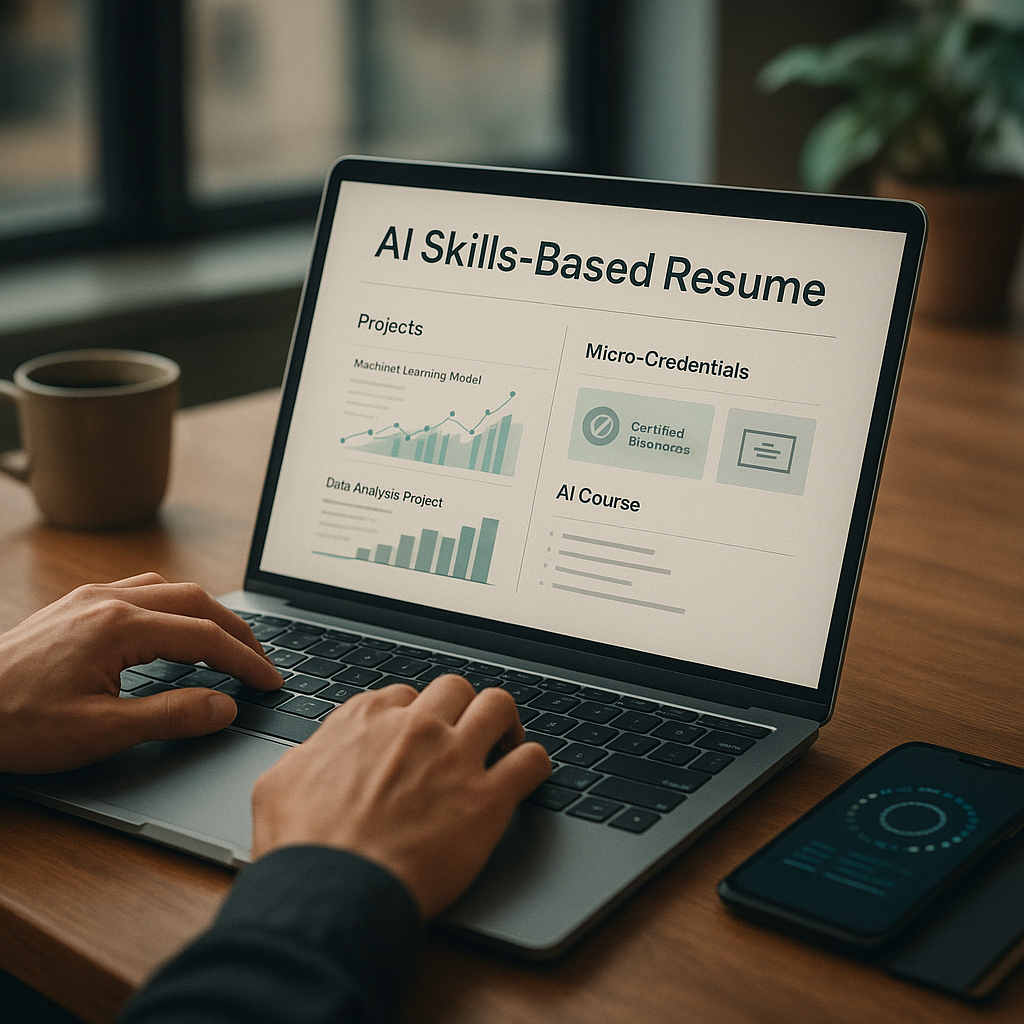
Micro-Credentials vs Certifications: What Recruiters Actually Trust (and How to Showcase Them on Your Resume)
Not all credentials carry the same weight—and some can hurt credibility if presented wrong. Learn how recruiters evaluate micro-credentials vs certifications by role, what signals real skill, and exactly how to format them on your resume and LinkedIn to get more interviews.

Not all credentials carry the same weight in 2025—and some can hurt credibility if presented wrong. A resume stacked with vague “certificates of completion” can read like noise, while one well-chosen certification or a portfolio-backed micro-credential can instantly reduce a recruiter’s risk and move you into the interview pile. The difference usually isn’t the logo—it’s how employers interpret signal vs. fluff, and whether you present proof in a way that aligns with how hiring actually happens now (ATS filters, skills-based screening, and shorter recruiter attention spans).
This guide breaks down how recruiters evaluate micro-credentials vs. certifications by role, what signals real skill in 2025, and exactly how to format both on your resume and LinkedIn so they increase interview chances instead of raising eyebrows.
Micro-Credentials vs Certifications: What They Actually Mean in 2025
What recruiters typically mean by “micro-credential”
In practice, recruiters use “micro-credential” to refer to short, skills-focused learning—often 2–40 hours—such as:
- Coursera/edX/Udacity professional certificates
- Google/Microsoft “career certificates”
- Vendor micro-badges (e.g., AWS digital badges, IBM badges)
- Short bootcamp credentials (not full programs)
- Platform certificates (DataCamp, Codecademy, LinkedIn Learning certificates of completion)
Recruiter interpretation (2025 reality): Micro-credentials are often treated as signals of interest and baseline literacy, not proof of job-ready capability—unless paired with evidence (project, assessment score, GitHub, case study, lab).
What recruiters typically mean by “certification”
A certification is usually interpreted as a proctored, standardized, externally validated credential, often requiring:
- A formal exam (sometimes proctored)
- Specific objectives and versioning
- Renewal/CEUs or expiration
- Vendor, association, or accredited issuer credibility
Examples:
- CompTIA Security+, Network+
- AWS Certified Solutions Architect
- Cisco CCNA
- SHRM-CP
- PMI CAPM/PMP
- Salesforce Administrator
- Microsoft role-based certifications
- CPA/CFA (these are even more regulated/credentialed)
Recruiter interpretation: Certifications tend to be seen as risk-reduction tools. They’re not a guarantee, but they can trigger ATS keywords, satisfy compliance requirements, and reassure hiring managers.
What Recruiters Actually Trust in 2025 (The “Signal Strength” Model)
Recruiters in 2025 are navigating three major pressures:
1. Higher application volume (especially for remote roles)
2. More AI-assisted screening (ATS + knockouts + skills questions)
3. More credential inflation (everyone has “certificates”)
So they evaluate credentials by signal strength, usually in this order:
1) Role-required or regulated credentials (highest trust)
These are credentials that are mandatory for the job or heavily expected:
- Licensed roles (nursing, engineering licenses, CPA)
- Compliance/security roles (often require Security+, CISSP, etc.)
- Project leadership roles (PMP is still a powerful shorthand)
Why trusted: They’re hard to fake, standardized, and often auditable.
2) Vendor certifications tied to the job’s tools (high trust)
Examples: AWS, Azure, Google Cloud, Salesforce, ServiceNow, Cisco.
Why trusted: Hiring teams want faster onboarding. A vendor cert maps directly to tools they use.
3) Micro-credentials with assessed work + portfolio proof (medium trust)
A micro-credential becomes credible when it includes:
- Graded projects
- Hands-on labs
- A capstone with deliverables
- A score, ranking, or third-party assessment
- Public artifacts (GitHub, dashboards, write-ups)
Recruiter logic: “This person didn’t just watch videos—they shipped something.”
4) Certificates of completion without proof (low trust)
LinkedIn Learning “completed” badges, short webinars, non-proctored “certificates” without assessments.
Recruiter logic: “This may be helpful, but it doesn’t differentiate you.”
5) Overstuffed credential lists (negative signal)
If your resume has 15+ micro-credentials, recruiters may infer:
- You’re collecting badges instead of building skills
- You lack real-world experience
- You may be trying to “keyword hack” ATS
In 2025, credibility is not about quantity—it’s about alignment + evidence.
Micro-Credentials vs Certifications by Role: What Works (and What Backfires)
Tech (IT, Cloud, Cybersecurity)
What recruiters trust most:
- Proctored vendor certifications (AWS/Azure/GCP, CompTIA, Cisco)
- Hands-on labs (especially for security)
- GitHub projects, infrastructure diagrams, incident write-ups
Micro-credentials that can help:
- Cloud labs + capstone architecture project
- Security labs demonstrating detection/response basics
- Data certs with real notebooks/dashboards
What backfires:
- Listing “Intro to Cybersecurity” courses without labs
- No project links, no tooling mentioned, no outcomes
Strong combo example:
- CompTIA Security+ + TryHackMe/HTB write-up (sanitized) + home lab + SIEM dashboard screenshots
Data/Analytics (Analyst, BI, Data Science)
What recruiters trust most:
- Proof of work: dashboards, notebooks, case studies
- Tool-specific credibility: SQL, Power BI/Tableau, Python, dbt
- Select certifications (not mandatory, but helpful)
Micro-credentials that can help (if paired with proof):
- Google Data Analytics Certificate (with portfolio projects)
- dbt Fundamentals (with a modeled project)
- Power BI micro-credentials (with a published report link)
What backfires:
- “Machine Learning” micro-credentials with no GitHub or business framing
- Overly academic course lists without applied outcomes
Strong combo example:
- Microsoft Power BI Data Analyst (PL-300) + 2 published dashboards + one case study with business impact
Product, Marketing, and Growth
What recruiters trust most:
- Outcomes: revenue growth, CAC improvements, conversion lift
- Tools: GA4, Ads platforms, CRM, experimentation tools
- Case studies and writing samples
Micro-credentials that help:
- GA4 training + a measurement plan you built
- SEO course + a live site audit + before/after metrics
- Experimentation micro-credential + documented A/B test
What backfires:
- Generic “digital marketing” certificates with no campaign proof
- Listing 10 micro-credentials but no portfolio or results
Strong combo example:
- Google Analytics (GA4) micro-credential + public teardown + one campaign case study with metrics
HR, People Ops, and Recruiting
What recruiters trust most:
- SHRM-CP / PHR (depending on market)
- Evidence of process improvements, employee programs, compliance familiarity
Micro-credentials that help:
- DEI training (if it includes implementation plan)
- Compensation basics with a sample leveling framework (anonymized)
What backfires:
- “People analytics” certificate without any dashboard/reporting examples
- Listing sensitive topics without showing practical application
Project/Program Management
What recruiters trust most:
- PMP (for experienced PMs), CAPM (entry-level), Scrum credentials (role-dependent)
- Examples: roadmaps, RAID logs, stakeholder comms
Micro-credentials that help:
- Jira/Confluence workflow micro-credential + a sample project board
- Agile courses only if you can show how you executed ceremonies and delivered outcomes
What backfires:
- Too many Agile badges with zero delivery examples
Feature Comparison: Micro-Credentials vs Certifications (Recruiter Lens)
| Dimension (Recruiter Lens) | Micro-Credentials | Certifications |
|---|---|---|
| Typical time investment | Low to moderate | Moderate to high |
| Validation strength | Varies widely; often unproctored | Usually standardized, exam-based |
| ATS keyword impact | Medium (depends on issuer + phrasing) | High for common certs (AWS, PMP, Security+) |
| Best use case | Prove momentum, skill exploration, tool familiarity | Meet job requirements, reduce hiring risk |
| Risk if overused | Looks like “badge collecting” | Can look mismatched if irrelevant/expired |
| What makes it credible | Assessed projects + portfolio artifacts | Exam score/report + recency + relevance |
| Best for career changers | Yes—when paired with projects | Yes—when aligned to target role |
| Recruiter trust baseline | Low-to-medium | Medium-to-high |
Bottom line: In 2025, micro-credentials earn trust through proof. Certifications earn trust through standardization + relevance.
How to Showcase Credentials Without Hurting Credibility (Resume + LinkedIn)
The #1 rule: Tie the credential to a job-relevant outcome
Don’t just list it. Make it do work for you.
Instead of:
- “Google Data Analytics Certificate”
Use:
- “Google Data Analytics Professional Certificate — Built 3 SQL + Tableau case studies (portfolio: link)”
Instead of:
- “AWS Cloud Practitioner”
Use:
- “AWS Certified Cloud Practitioner — Deployed a 3-tier demo app on AWS (diagram + cost controls)”
Resume formatting: the exact sections recruiters scan
Use a dedicated section, but keep it tight.
Option A: Separate “Certifications” section (best when you have 1–6)
textCERTIFICATIONS
AWS Certified Solutions Architect – Associate (SAA-C03), 2025
CompTIA Security+, 2024
Microsoft Certified: Azure Fundamentals (AZ-900), 2024
Option B: “Certifications & Micro-Credentials” (best for hybrid profiles)
textCERTIFICATIONS & MICRO-CREDENTIALS
Salesforce Certified Administrator, 2025
Google Data Analytics Professional Certificate (capstone + portfolio), 2024
dbt Fundamentals (hands-on project: GitHub link), 2024
Option C: Embed in “Skills” when it’s a core screening keyword
This helps ATS and recruiters see relevance immediately.
textSKILLS
Cloud: AWS (SAA), IAM, VPC, EC2, S3 • Security: Threat modeling, SIEM (Security+)
Add proof: one link beats five badges
Recruiters increasingly look for work artifacts, especially for micro-credentials.
Add:
- Portfolio link (Notion, GitHub, personal site)
- One strong project per credential
- A short descriptor (what you built, tool used, outcome)
Example:
textGoogle UX Design Certificate — Designed mobile checkout flow; prototype + usability notes (portfolio link)
LinkedIn: where to place micro-credentials so they don’t look like “fluff”
LinkedIn has multiple spots—use the ones recruiters actually check.
1) Headline (only for high-signal credentials)
Good:
- “Data Analyst | SQL | Power BI (PL-300) | Portfolio: link”
Avoid:
- Listing 4–6 micro-credentials in the headline
2) Featured section (best place for proof)
Add:
- Your best project (dashboard, case study, GitHub repo)
- A one-page “capstone summary” PDF
- A short Loom walkthrough (if relevant)
3) Licenses & Certifications (keep it clean)
- Include issuer, year, credential ID (if available)
- Don’t add every webinar certificate
4) About section: translate credential → capability
Example snippet:
“Recently completed PL-300 and built Power BI dashboards using SQL-based models and DAX. Featured project: churn dashboard with cohort analysis (link).”
2025 Playbook: Choosing the Right Credential Mix (Without Wasting Money)
Step 1: Start with job postings—count, don’t guess
Pull 20–30 job descriptions for your target role. Track:
- Required vs preferred certifications
- Tools mentioned repeatedly
- Years of experience expectations
- “Nice-to-have” keywords
If a certification appears in 25–40%+ of postings in your niche, it’s often worth prioritizing. If it’s only in 5%, it may be optional unless you’re targeting that specific subset.
Step 2: Pick one “anchor credential” + one “proof credential”
A practical 2025 combo looks like:
- Anchor credential (trust signal): a recognized certification recruiters filter for
- Proof credential (skill signal): a micro-credential or course plus a project
Examples:
- IT Support: CompTIA A+ (anchor) + Microsoft 365 labs (proof)
- Cloud: AWS SAA (anchor) + Terraform project (proof)
- Analytics: PL-300 (anchor) + SQL portfolio case study (proof)
- Marketing: Meta/Google Ads certification (anchor) + campaign teardown (proof)
Step 3: Build one artifact per credential (minimum)
For each credential, create one of:
- Case study (1 page)
- GitHub repo with README and screenshots
- Dashboard link + short business narrative
- Architecture diagram + cost/security notes
This is how micro-credentials become “real” in recruiter eyes.
Step 4: Don’t list credentials you can’t defend in conversation
Recruiters and hiring managers will probe:
- “What did you build?”
- “What tradeoffs did you make?”
- “What would you do differently?”
If you can’t answer, the credential becomes a liability.
How Apply4Me Helps You Turn Credentials Into Interviews (Without Spamming Applications)
In 2025, the hardest part isn’t earning a credential—it’s showing it the right way, to the right roles, consistently. This is where many job seekers lose weeks: applying randomly, forgetting follow-ups, and not learning what’s working.
Apply4Me is useful here because it focuses on execution and feedback loops, not just “apply more.”
Use the Job Tracker to align credentials with the right roles
A credential only helps if it matches what the job is screening for. With a job tracker, you can:
- Tag roles by track (e.g., “Cloud Support,” “Security Analyst,” “BI Analyst”)
- Note which postings require which certifications
- See patterns (e.g., “Security+ shows up in 60% of my target roles”)
Use ATS Scoring to stress-test how you list credentials
Small wording choices affect ATS parsing. ATS scoring helps you check whether:
- The credential is recognized (e.g., “AWS Certified Solutions Architect – Associate” vs “AWS Solutions Architect”)
- You included the exam code (SAA-C03, PL-300) when relevant
- The credential is placed in a section ATS reads reliably
Use Application Insights to learn which credentials actually move the needle
If you’re applying across similar roles, insights can help you spot:
- Which resume version gets more responses
- Whether highlighting the certification near the top improves callbacks
- Whether micro-credential + portfolio link increases recruiter engagement
Use the Mobile App to keep follow-ups from falling through
Credentials help you get noticed; follow-ups help you get hired. A mobile workflow makes it easier to:
- Apply consistently
- Track recruiter conversations
- Follow up 5–7 business days after applying (without losing track)
Use Career Path Planning to avoid credential “wandering”
This is a big 2025 problem: people collect credentials across unrelated paths (data + UX + PM + cybersecurity) and end up with a “confused profile.” Career path planning helps you commit to:
- One target role (or two adjacent roles)
- The credential sequence that supports it
- The projects that prove it
Implementation Checklist: Fix Your Credential Section This Week
Use this checklist to make your credentials recruiter-trustworthy in under an hour:
1. Delete any certificate of completion that doesn’t support your target role.
2. Keep 1–3 high-signal credentials (certifications or assessed programs) near the top.
3. For each micro-credential you keep, add one proof link (portfolio/GitHub/case study).
4. Add year + issuer + exact credential name (match job postings).
5. Add exam code where applicable (PL-300, SAA-C03, etc.).
6. Ensure recency is visible (2024/2025 matters in fast-changing tools).
7. In your Experience or Projects section, include one bullet tying the credential to output:
- “Built…” “Deployed…” “Analyzed…” “Automated…”
8. On LinkedIn, move proof into Featured, not just “Licenses & Certifications.”
9. Create two resume versions:
- One emphasizing certifications (for roles that screen for them)
- One emphasizing projects (for skills-based roles)
10. Track results for 2–3 weeks and adjust based on response rate.
Conclusion: Make Credentials a Signal, Not a Screenshot
In 2025, recruiters don’t automatically distrust micro-credentials—and they don’t automatically trust certifications either. What they trust is relevance, validation, and proof of application. Certifications are powerful when they match the role and reduce risk. Micro-credentials work when they’re backed by real artifacts and presented with restraint.
If you want to turn credentials into interviews faster, focus on a tight credential strategy, link it to proof, and track what’s working. Apply4Me can help you stay organized with a job tracker, improve how your resume reads with ATS scoring, learn from application insights, and stay consistent via the mobile app—plus map a clear credential path so your profile tells one coherent story.
Soft next step: try Apply4Me for a week while you refine your credential section and track which version of your resume gets the best responses.

Jorge Lameira
Author