Recruiter-First Resumes: How to Optimize for Human Scans After ATS (Plus a 30-Second Summary Template)
In, getting past the ATS is only step one—most rejections happen when a recruiter does a fast, messy skim. Learn the exact layout, proof cues, and top-of-page summary that make your resume instantly legible and credible in under 30 seconds.

In 2025, getting past the ATS is only step one—most rejections happen after your resume is already “qualified.” Why? Because recruiters don’t read resumes like books. They do a fast, messy skim between meetings, on small screens, while juggling 20–60 open reqs, Slack pings, and hiring-manager feedback. If your resume doesn’t become legible and credible in under 30 seconds, it often gets deprioritized—even if you’re a strong match.
This post breaks down what a recruiter-first resume looks like in 2025: the exact layout that survives a skim, the proof cues recruiters trust, and a top-of-page summary template you can tailor in minutes.
The 2025 Reality: ATS Pass ≠ Recruiter Pass
Most job seekers optimize heavily for ATS keywords and forget the second gate: human scanning. By the time your resume hits a recruiter’s screen, the question usually isn’t “Does this include the right words?” It’s:
- “Do I understand what this person does in 5 seconds?”
- “Do they match this role’s priorities in 15 seconds?”
- “Do I see proof—metrics, scope, tools, outcomes—in 30 seconds?”
- “Is this easy to forward to a hiring manager without explaining it?”
What recruiter scanning actually looks like
Recruiter behavior varies, but the pattern is consistent across internal and agency recruiting:
- Top third of page gets the most attention. If it’s vague, you’ve lost the skim.
- They look for role alignment, not life story. Your “Career Objective” is still dead.
- They scan for credibility signals: brand names, titles, dates, progression, scope, metrics, tool stacks, certifications (only if relevant), and evidence of impact.
Key idea: Your resume must be ATS-readable and human-scannable. Optimizing for one but not the other is the most common “qualified but rejected” scenario.
The Recruiter-First Layout: A Skimmable Structure That Works in 2025
A recruiter-first resume is built like a dashboard: clear headers, consistent formatting, and “proof” placed where eyes naturally land.
The fastest-scanning resume order (recommended)
Use this order unless you’re an early-career candidate with limited experience:
1. Header (name, title, links)
2. 30-second summary (role + fit + proof)
3. Core skills (tight, role-specific)
4. Experience (impact bullets + scope)
5. Education
6. Certifications / projects / publications (only if they strengthen the role match)
Header: make it frictionless
Your header should be clean and clickable. Include:
- Name
- Target title (matches the job posting language)
- City, state (or “Remote”)
- Phone + professional email
- LinkedIn + portfolio/GitHub (if applicable)
Avoid: full street address, multiple emails, and “open to anything” titles.
Recruiter-first tip: Put your target title directly under your name (e.g., Product Marketing Manager | B2B SaaS). That one line reduces recruiter guesswork.
The 30-Second Summary: A Template Recruiters Actually Use
The top-of-page summary is the highest-leverage section in 2025 because it answers the recruiter’s first question: “What is this person?”
Your summary must do three things fast
1. Identity: what you do (role + niche)
2. Fit: what you do that matches this job (2–3 priorities)
3. Proof: metrics, scope, tool stack, recognizable outcomes
If your summary is vague (“results-driven professional”), it’s functionally invisible.
The 30-Second Summary Template (copy/paste)
Use this exact structure:
[Target Role] with [X years] in [industry / domain], specializing in [2–3 role-specific strengths tied to the job description]. Known for [1–2 measurable outcomes] across [scope: team size, budget, pipeline, revenue, users, regions, etc.]. Experienced with [tools/stack relevant to the role]; strong partner to [stakeholders].
#### Example 1: Data Analyst (business-facing)
Data Analyst with 5 years in B2C fintech, specializing in SQL analytics, dashboarding, and experimentation insights. Known for reducing churn 8% by identifying behavioral segments and improving lifecycle triggers across 2M+ users. Experienced with BigQuery, dbt, Looker, and GA4; strong partner to Product, Growth, and Customer Success.
#### Example 2: Customer Success Manager (SaaS)
Customer Success Manager with 6 years in B2B SaaS, specializing in renewals, onboarding, and expansion for mid-market accounts. Known for driving 112% NRR and improving renewal rates by 9 points across a $2.4M book of business. Experienced with Gainsight, Salesforce, Zendesk, and Gong; trusted partner to Sales and Product.
#### Example 3: Software Engineer (backend)
Backend Software Engineer with 4 years building high-throughput services in Python/Go, specializing in API design, distributed systems, and cloud cost optimization. Known for cutting latency 35% and reducing AWS spend 18% across services handling 50M+ events/day. Experienced with AWS, Kubernetes, Postgres, Redis, and Terraform; strong collaborator with SRE and Product.
Summary rules that make recruiters trust you
- Mirror the job description language (titles, tools, priorities).
- Quantify at least one outcome (even if approximate).
- Include scope (users, $ responsibility, regions, pipeline, scale).
- Avoid adjectives without proof (“innovative,” “dynamic”).
Proof Cues Recruiters Scan For (and How to Place Them)
Recruiters are trained (formally or informally) to look for “proof” patterns. If your resume hides proof below paragraphs, it loses the skim.
The “proof density” principle
Aim for 1 proof cue per 1–2 bullets in your most recent role.
Proof cues include:
- Metrics: %, $, time saved, volume, conversion, latency, SLA, NPS
- Scope: number of accounts, ARR, users, markets, stakeholders
- Tools: CRM, BI, cloud platforms, frameworks (only relevant ones)
- Progression: promotions, increased responsibility
- Selectivity: awards, competitive programs, certifications (when role-relevant)
Strong bullet formula (use this)
Action + What + Why + Result + Scope/Tools
Before (weak):
- Responsible for reporting and dashboards.
After (recruiter-first):
- Built Looker dashboards for Exec + Growth teams, reducing weekly reporting time 6 hours and standardizing KPIs across 12 markets.
“Show me you’ve done it lately” (recency matters in 2025)
Recruiters heavily weight your most recent 1–2 roles. Put your best, most relevant proof there—even if it means trimming older roles to 2–3 bullets.
Rule of thumb:
- Most recent role: 4–6 bullets
- Previous role: 3–5 bullets
- Older roles: 1–3 bullets or condensed
Add a “Tech/Tools” line only if it helps skim speed
For technical, operations, analytics, marketing ops, and sales ops roles, a compact tools line can help:
Tools: SQL (BigQuery), dbt, Looker, GA4, Amplitude, Segment
Keep it tight. Do not list 25 tools.
Make It Instantly Legible: Formatting That Wins the Skim
Recruiter-first resumes are built for messy reality: small screens, quick scrolls, and inconsistent attention.
Formatting rules for 2025 (practical, not theoretical)
#### 1) Use a single-column layout
Two-column templates often break ATS parsing and confuse human scanning. A single column is cleaner for forwarding, printing, and mobile viewing.
#### 2) Keep typography boring (boring is good)
- Font: Calibri, Arial, Helvetica, or a modern sans-serif (10.5–11.5 pt)
- Line spacing: 1.0–1.15
- Section headers: bold + slightly larger
- Dates aligned right (consistent)
#### 3) Use consistent role headers
A recruiter should be able to parse your experience in 2 seconds:
Company — Title (City/Remote)
Dates
- Bullet
- Bullet
If your dates jump around, your credibility takes a hit—even if you’re strong.
#### 4) Make keywords “visible,” not stuffed
ATS likes keywords, but humans hate walls of buzzwords. The fix is a Core Skills section with role-specific keywords, then prove them in bullets.
Core Skills (example, PMM):
Positioning • Messaging • Competitive intel • GTM strategy • Sales enablement • Lifecycle campaigns • Win/loss analysis • SQL (basic) • HubSpot • Salesforce
#### 5) Use scannable anchors
Recruiters often anchor on:
- Company names
- Titles
- Dates
- Metrics
- Known tools
Help them: bold sparingly (metrics and role outcomes), avoid italics overload, and don’t bury company names.
ATS + Human Optimization: How to Tailor Fast Without Rewriting Everything
Tailoring in 2025 isn’t about reinventing your resume for every job. It’s about swapping the top layer (summary + skills + most relevant bullets) to match the posting.
The 15-minute tailoring process (repeatable)
1. Copy the job description into a scratch doc
2. Highlight:
- Role title variants
- 6–10 priority keywords (tools + responsibilities)
- 3 outcomes they care about (growth, retention, speed, accuracy, risk reduction, etc.)
3. Update:
- Target title under your name
- 30-second summary (match 2–3 priorities)
- Core skills (only what you can prove)
- Top 2 roles: reorder bullets so the most relevant are first
4. Add 1 “bridge bullet” if needed
Example: if the job emphasizes stakeholder management, add a bullet that proves it with scope and cadence.
Don’t tailor like this (common 2025 mistake)
- Stuffing keywords into skills without proof
- Copying the entire job description into your resume
- Adding tools you “touched once” and can’t speak to
Recruiters are faster at detecting inflated claims than candidates expect—especially in competitive markets.
Using Apply4Me to Build a Recruiter-First Workflow (Without Getting Lost)
A recruiter-first resume is only half the battle—you also need a system to iterate quickly, learn from outcomes, and stay consistent across applications. This is where Apply4Me fits naturally into a 2025 job search.
What Apply4Me helps with (practically)
- Job tracker: Track roles, versions, and statuses so you’re not guessing which resume you used where.
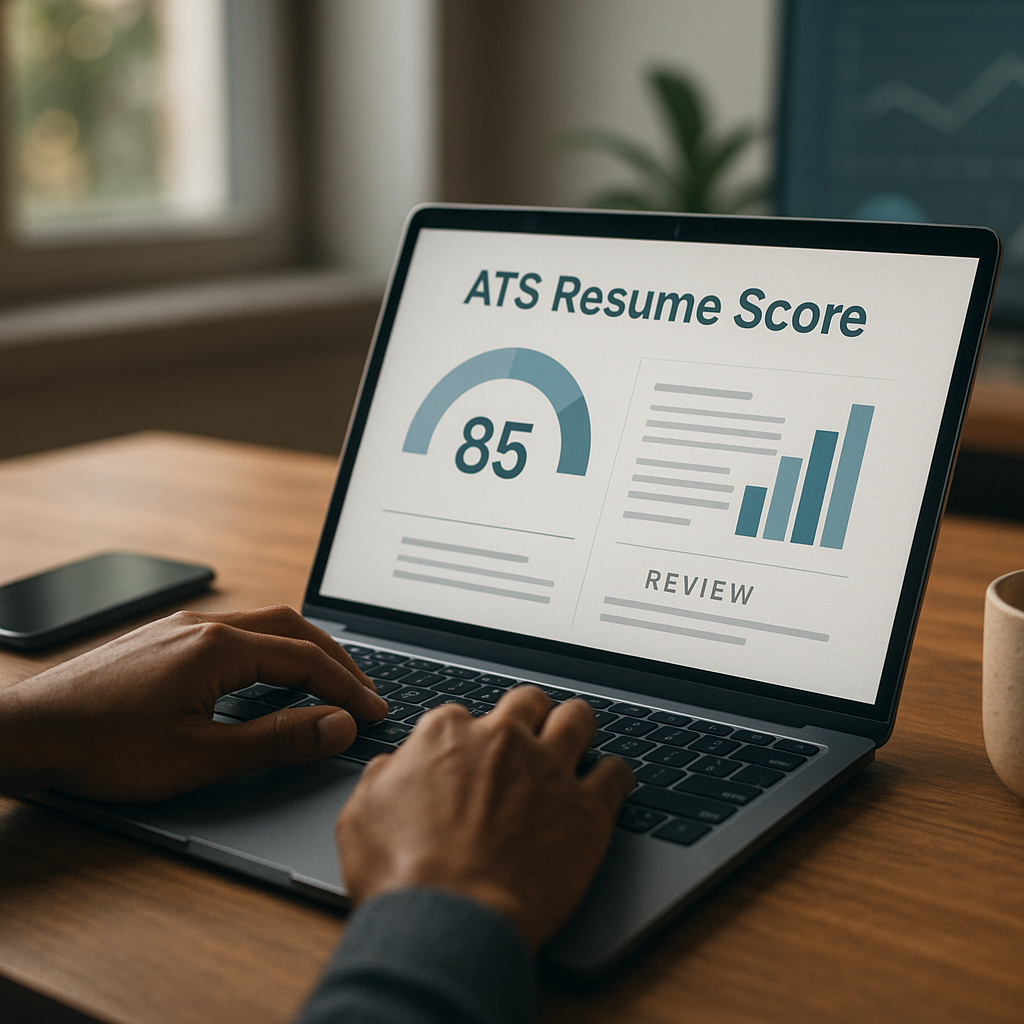
- ATS scoring: A quick way to sanity-check keyword alignment before you submit (useful—but don’t treat it as gospel).
- Application insights: Helps you see patterns (e.g., which resume version gets more interviews, which titles convert better).
- Mobile app: Keep the job search moving—save postings, update statuses, and review next steps on the go.
- Career path planning: Useful if you’re pivoting or unsure which target title to commit to; it helps structure your “role narrative.”
Honest pros and cons (so you use it correctly)
Pros
- Reduces chaos (which is often the real job-search killer)
- Encourages iteration (resume versioning + insights)
- ATS scoring is a fast “first check” for alignment
Cons
- ATS scoring can tempt people into keyword stuffing if used blindly
- No tool can replace real proof: your bullets still need outcomes and scope
Best use: Treat tools as feedback loops. Your goal is not to “game the ATS,” it’s to create a resume that reads like a clean business case for hiring you.
Implementation: Build Your Recruiter-First Resume in 60 Minutes
Here’s a step-by-step plan you can run today.
Step 1: Fix the top third of page (20 minutes)
- Add target title under your name
- Paste in the 30-second summary template
- Add Core Skills (8–14 skills max; only what you can prove)
Step 2: Rewrite your top 6 bullets (25 minutes)
For your most recent role, rewrite 4–6 bullets using:
Verb + Deliverable + Business purpose + Result + Scope/Tools
If you’re stuck on metrics:
- Use ranges (“~10–15%”)
- Use volume (“processed 300+ tickets/week”)
- Use time (“cut cycle time from 10 days to 6”)
- Use scope (“supported 25 enterprise accounts”)
Step 3: Reorder bullets for skimming (10 minutes)
Put the most role-relevant bullet first in each job. Recruiters often stop after the first 2–3 bullets per role.
Step 4: Run a 30-second skim test (5 minutes)
Open your resume and ask:
- Can I tell what role you are in 5 seconds?
- Do I see proof in the first 15 seconds?
- Can I explain your fit to a hiring manager in 30 seconds?
If not, tighten the summary and move a proof-heavy bullet higher.
Conclusion: Optimize for the Human Scan—and Your Interviews Go Up
In 2025, ATS optimization gets you seen, but recruiter-first design gets you selected. When your resume becomes instantly legible—clear target title, sharp 30-second summary, proof-dense bullets, and a clean layout—you stop losing opportunities to messy skims.
If you want to operationalize this (track versions, measure what’s working, and keep your applications organized), try Apply4Me as a companion to your recruiter-first resume—especially for the job tracker, ATS scoring, and application insights that help you iterate faster without burning out.
30-Second Summary Template (Quick Copy)
[Target Role] with [X years] in [industry/domain], specializing in [2–3 strengths aligned to the posting]. Known for [1–2 measurable outcomes] across [scope]. Experienced with [relevant tools/stack]; strong partner to [stakeholders].

Jorge Lameira
Author