AI Resume Personalization: How to Tailor Every Application Without Sounding Generic (Plus an ATS Score Checklist)
Generic AI resumes are getting filtered out faster than ever. Learn a repeatable, role-by-role tailoring system that keeps your voice intact, aligns with job keywords, and improves ATS performance—plus a practical checklist to validate each version before you apply.
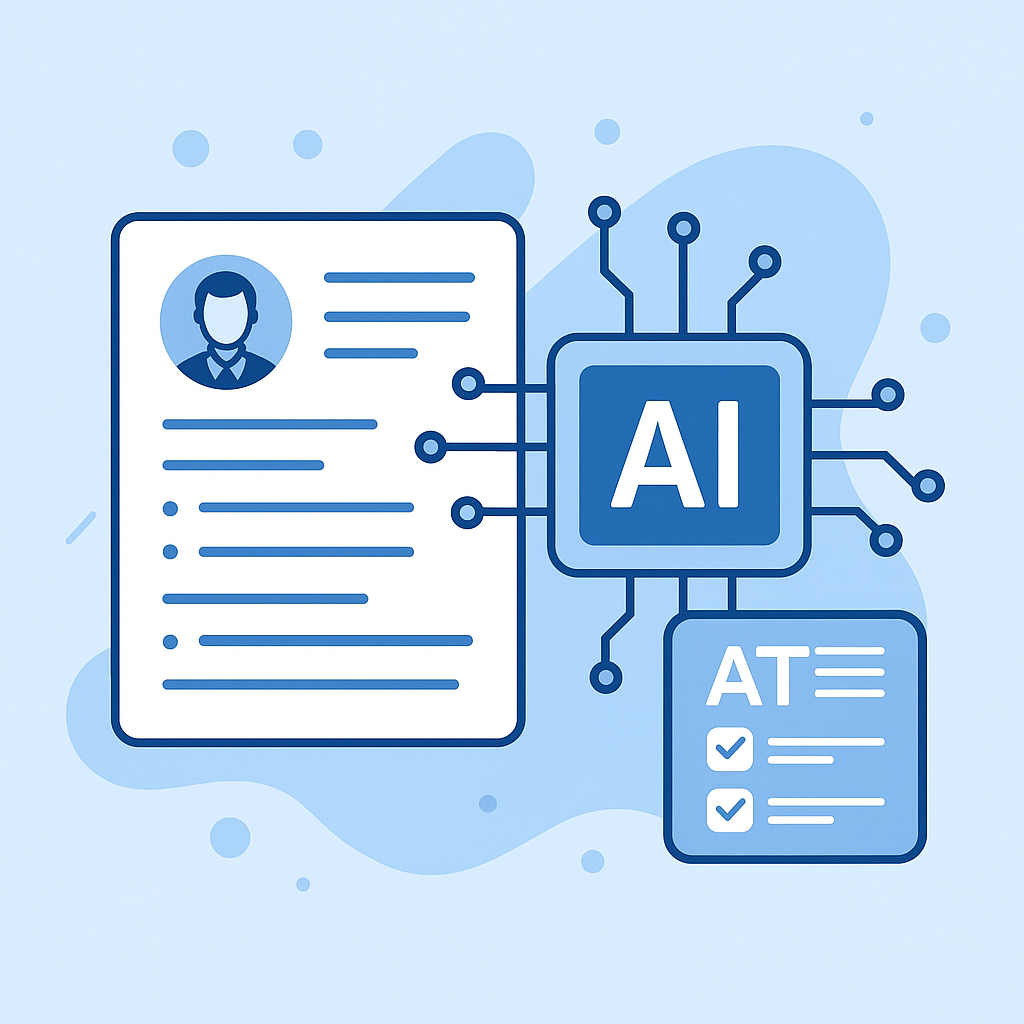
Generic AI resumes are getting filtered out faster than ever in 2025—and not just by ATS. Recruiters and hiring managers have become fluent in the “AI voice”: overly polished summaries, vague impact, and suspiciously universal skill lists that could describe anyone. The result: your resume might be technically optimized, yet still reads like it was generated for a job that doesn’t exist.
This guide gives you a repeatable, role-by-role personalization system that keeps your voice intact, aligns with job keywords, and improves ATS performance—plus an ATS score checklist you can use before you hit “Apply.”
Why generic AI resumes fail in 2025 (even when they look “optimized”)
In 2025, most employers are doing some combination of:
- ATS parsing + ranking (keyword coverage, recency, relevance, role similarity)
- Recruiter “pattern recognition” scanning (authenticity, specificity, credible metrics)
- AI-assisted screening (summarization, mismatch detection, requirement mapping)
- Skills/portfolio verification (links, work samples, assessments, GitHub, case studies)
When your resume is generic, it fails in predictable ways:
1) It matches keywords but not requirements
Many AI-written resumes include broad terms like “cross-functional collaboration” or “data-driven strategy” without tying them to the actual required outcomes in the job post (e.g., “reduce churn by 10%” or “build Power BI dashboards for finance stakeholders”).
Hiring teams notice the mismatch quickly. And modern screeners can detect low-specificity content: sentences with action verbs but no anchored context (tools, stakeholders, scope, metrics).
2) It repeats the same “AI phrases” everyone uses
Recruiters increasingly flag phrases like:
- “Results-driven professional”
- “Proven track record”
- “Strategic thinker”
- “Leveraged synergies”
- “Dynamic self-starter”
Not because they’re “bad,” but because they don’t differentiate you—and often signal content that hasn’t been carefully tailored.
3) It over-optimizes for ATS and under-delivers on credibility
A resume stuffed with keywords can score higher—yet lose the human reader in the first 15 seconds. In 2025, the winners balance machine readability with narrative precision: the same keywords, but supported by evidence.
The 2025 personalization approach: Tailor to the “role problem,” not just the job title
Most advice says “tailor your resume to the job description.” In 2025, that’s necessary but not sufficient.
A better approach: tailor to the role’s problem statement.
A job post usually signals 2–3 core problems:
- A Product Manager role might be about activation and retention, not “product strategy.”
- A Data Analyst role might be about cleaning messy data and building stakeholder dashboards, not “SQL and reporting.”
- A Customer Success Manager role might be about renewals and expansion, not “relationship building.”
Step 1: Extract a “Role Problem Map” (5 minutes)
Copy the job description into a doc and pull out:
1. Outcomes (what success looks like)
Examples: reduce churn, improve conversion, ship roadmap, shorten cycle time, increase pipeline.
2. Capabilities (how they expect you to do it)
Tools, systems, methods: Salesforce, SQL, Python, Jira, GA4, HubSpot, AWS, stakeholder management.
3. Context (where/how the work happens)
Industry, team structure, product stage, compliance, remote/hybrid, customer segment (SMB vs enterprise).
Now you have the target your resume needs to match.
Step 2: Choose a “Top 10” keyword list (not 40)
Many job seekers try to mirror every phrase in the posting. That creates clutter and makes your resume feel synthetic.
Instead, build a Top 10 list:
- 3 keywords related to outcomes (e.g., retention, churn, expansion)
- 4 keywords related to tools/process (e.g., Salesforce, Gainsight, QBRs, health scoring)
- 3 keywords related to domain/context (e.g., B2B SaaS, mid-market, onboarding)
These are the terms you’ll reinforce across:
- Summary
- Skills
- 1–2 bullets per relevant role
- Project section (if you have one)
A repeatable role-by-role tailoring system (that preserves your voice)
Here’s the workflow that avoids “generic AI resume syndrome” while still letting AI do the heavy lifting.
1) Start with a “master resume” built for evidence, not keywords
Your master resume should be the inventory of proof:
- Strong bullet points with scope + metric + method
- Real tools you used
- Named stakeholders (finance, sales ops, engineering)
- Projects that show depth
Think of it like a database. Tailoring isn’t rewriting your life—it’s selecting and ordering what matters for this role.
2) Create a role-specific “positioning summary” (3 lines)
The summary is where generic AI content is most obvious. Fix that by using a structured template:
Summary template (3 lines):
1. Who you are + domain + years (avoid fluff)
2. The role problem you solve (outcome-aligned)
3. Proof markers (tools + metrics + scope)
Example (Customer Success Manager, B2B SaaS):
Customer Success Manager with 6+ years in B2B SaaS (mid-market + enterprise). Focused on reducing churn and expanding adoption through onboarding programs, QBRs, and health scoring. Led renewal plays that improved GRR by 7 points and increased expansion pipeline by $420K using Salesforce + Gainsight.
Notice what’s missing: “results-driven” and “proven track record.” It’s specific without being long.
3) Reorder experience bullets to match the job’s priorities
In 2025, resume screeners weigh relevance + recency heavily. That means your best bullet shouldn’t be buried.
For each role, choose:
- 2 bullets aligned to the job’s top outcomes
- 1 bullet aligned to tools/process
- 1 bullet aligned to collaboration/stakeholders (only if relevant)
Before (generic):
- Collaborated with cross-functional teams to improve customer experience.
- Managed accounts and delivered insights to stakeholders.
- Increased retention and customer satisfaction.
After (role-aligned + credible):
- Reduced churn risk by launching a health score model (usage + support signals), improving at-risk identification and lifting renewal rate by 6% over two quarters.
- Led onboarding for 40+ mid-market customers/month, cutting time-to-value from 21 to 12 days through playbooks and milestone tracking in Gainsight.
- Partnered with Sales and Product to run QBRs and expansion planning, generating $420K in expansion pipeline.
Same candidate. Completely different impact.
4) Add a “Selected Projects” section when your experience isn’t a perfect match
If you’re pivoting (e.g., analyst → product, operations → PM, teacher → L&D), projects help ATS and humans see relevance.
Projects should include:
- Objective (one line)
- Tools
- Output
- Metric/result (even a proxy metric like time saved)
Example (Data Analyst project):
- Customer Churn Dashboard (SQL, dbt, Looker): Built cohort retention dashboard for 3 product lines; reduced weekly reporting time by ~4 hours and enabled churn review in exec meeting.
5) Use AI for rewriting—with constraints
AI can help you tailor, but only if you constrain it so it doesn’t flatten your voice.
Prompt framework that works in 2025:
- Give AI the job post
- Give it 5–8 proof bullets from your master resume
- Tell it what not to do (no clichés, no invented metrics)
- Require output in your structure
Example prompt:
Rewrite these resume bullets for a Customer Success Manager role. Keep my tone direct and specific. Do not add metrics I didn’t provide. Avoid phrases like “results-driven,” “proven track record,” “synergy,” “dynamic,” or “leveraged.” Use verbs that match the job description. Keep each bullet under 2 lines.
Then you edit for accuracy and voice.
Tool comparison in 2025: What actually helps with personalization (and what doesn’t)
There are more “AI resume tools” than ever. They’re not equal—and some can hurt you by producing identical-sounding outputs.
What to look for in a personalization tool
- Keyword mapping to requirements (not just “skills”)
- ATS parsing checks (formatting, headings, file type)
- Version control (role-by-role resume variants)
- Application insights (which versions perform better)
- Job tracking (so your process stays organized)
Common tool categories (pros/cons)
#### 1) Generic AI chat tools
Pros: flexible, fast, good for rewrites and brainstorming
Cons: easy to generate generic language; no built-in ATS checks; weak version management
#### 2) Resume scanners / ATS simulators
Pros: help identify missing keywords and parsing issues
Cons: scores can be misleading if they reward keyword stuffing; may not reflect your target company’s ATS rules
#### 3) All-in-one application platforms (where Apply4Me fits)
Pros: connect personalization to execution—tracking, scoring, and insights across applications
Cons: still requires your judgment; “score chasing” can distract from quality if you let it
How Apply4Me can help (without making you sound generic)
Apply4Me is most useful when you treat it as your system—not your writer.
Unique features that support real personalization:
- Job tracker: Keeps each application tied to the correct resume version and notes (so you don’t reuse the wrong content).
- ATS scoring: Helps you validate keyword coverage and formatting before submitting.
- Application insights: Lets you see patterns across your applications (e.g., which roles get callbacks, where your targeting is off).
- Mobile app: Makes it easier to capture postings, edit notes, and stay consistent when you’re applying on the go.
- Career path planning: Helps you target roles strategically so you’re not tailoring endlessly to jobs that don’t match your trajectory.
Used well, these features reduce the “apply-and-forget” spiral—and make tailoring sustainable.
The 2025 ATS Score Checklist (use this before every application)
You don’t need a perfect score. You need clean parsing + high relevance + credible evidence.
A) Parsing & formatting (ATS must-read)
- [ ] File type matches the posting (PDF or DOCX). If unsure, use DOCX.
- [ ] Standard headings: Summary, Experience, Education, Skills (avoid creative labels).
- [ ] No text boxes, tables, columns, icons, or embedded images.
- [ ] Dates are consistent (e.g., Jan 2022 – Mar 2025).
- [ ] Company, title, location clearly labeled per role.
- [ ] Bullets are real text characters (not special symbols that break parsing).
- [ ] Contact info is plain text at top (name, phone, email, LinkedIn).
B) Keyword alignment (relevance without stuffing)
- [ ] Your resume includes the Top 10 keywords from the job post naturally.
- [ ] Keywords appear in Experience bullets, not only Skills.
- [ ] You matched tool names exactly (e.g., “GA4” vs “Google Analytics” if the post says GA4).
- [ ] You included seniority signals appropriate to the role (leadership, ownership, scope).
- [ ] You removed keywords that aren’t relevant (noise can dilute match).
C) Evidence quality (what humans and AI screeners look for)
- [ ] At least 50% of bullets include a measurable result (revenue, time, cost, conversion, cycle time, NPS, uptime).
- [ ] Every major claim includes how you did it (tool, method, stakeholder, workflow).
- [ ] No vague openers (“helped,” “assisted,” “worked on”) unless paired with concrete scope.
- [ ] Metrics are believable and scoped (time period, baseline when possible).
- [ ] You didn’t include “responsible for” bullets without outcomes.
D) Role fit signals (the “this person has done it” test)
- [ ] Your first 2 bullets under your most recent role match the job’s top outcomes.
- [ ] Your summary mentions the role’s problem (not just the title).
- [ ] You show domain/context fit (industry, customer type, scale, compliance).
- [ ] If you’re pivoting, you added a Projects section that mirrors the role.
E) Final quality control (anti-generic checks)
- [ ] No cliché phrases (“results-driven,” “proven track record,” “team player”).
- [ ] No inflated claims you can’t defend in an interview.
- [ ] The resume sounds like you: consistent verbs, consistent specificity, consistent tone.
- [ ] The resume is 1 page (early career) or 2 pages (experienced), unless your industry expects CV-length.
- [ ] You saved the file name clearly: First_Last – Role – Company – 2025.pdf
If you’re using an ATS scoring tool (including Apply4Me’s ATS scoring), aim for a score that reflects true alignment—then sanity-check with sections C–E so you don’t “optimize into generic.”
Implementation: A fast personalization routine you can repeat for every role
Here’s a practical, sustainable routine—especially useful if you’re applying to 10–20 roles/week.
1) Build three “base versions” (instead of rewriting from scratch)
Create 3 templates aligned to your target directions, such as:
- Version A: Growth / Marketing Ops
- Version B: Customer Success / Account Management
- Version C: Data / Analytics
For each job, you’ll start from the closest base and do light tailoring—not a full rebuild.
2) Spend 20 minutes tailoring, max
A good allocation:
- 5 min: Role Problem Map + Top 10 keywords
- 8 min: Summary + reorder bullets (most recent role)
- 5 min: Skills + tools alignment
- 2 min: Run ATS check + formatting scan
If you’re spending 90 minutes per application, you won’t maintain consistency—and inconsistency kills results.
3) Track outcomes like an experiment
If you don’t track, you can’t improve. Track:
- Role type
- Company size/industry
- Resume version used
- ATS score (if available)
- Callback outcome
Apply4Me’s job tracker and application insights are designed for exactly this—so you can spot patterns (e.g., “I’m getting interviews for mid-market roles but not enterprise” or “My analytics version performs better when I lead with dashboards vs automation”).
4) Don’t tailor only the resume
In 2025, the best-performing candidates align:
- Resume keywords
- LinkedIn headline + “About”
- A short cover note (even 5–7 lines in an application text box)
- Work samples / portfolio
Even small consistency boosts credibility.
Conclusion: Personalization wins in 2025—but only when it’s specific
AI makes it easier to produce a resume. That’s not the competitive advantage anymore. The advantage is producing a resume that feels unmistakably human: specific, evidence-based, aligned to the role’s real problems, and formatted for clean ATS parsing.
If you want a workflow that keeps every application organized while helping you validate ATS alignment, try Apply4Me as your personalization companion—especially for its job tracker, ATS scoring, application insights, mobile app, and career path planning. Used with the system above, it can help you tailor faster without falling into the generic-AI trap.

Jorge Lameira
Author